

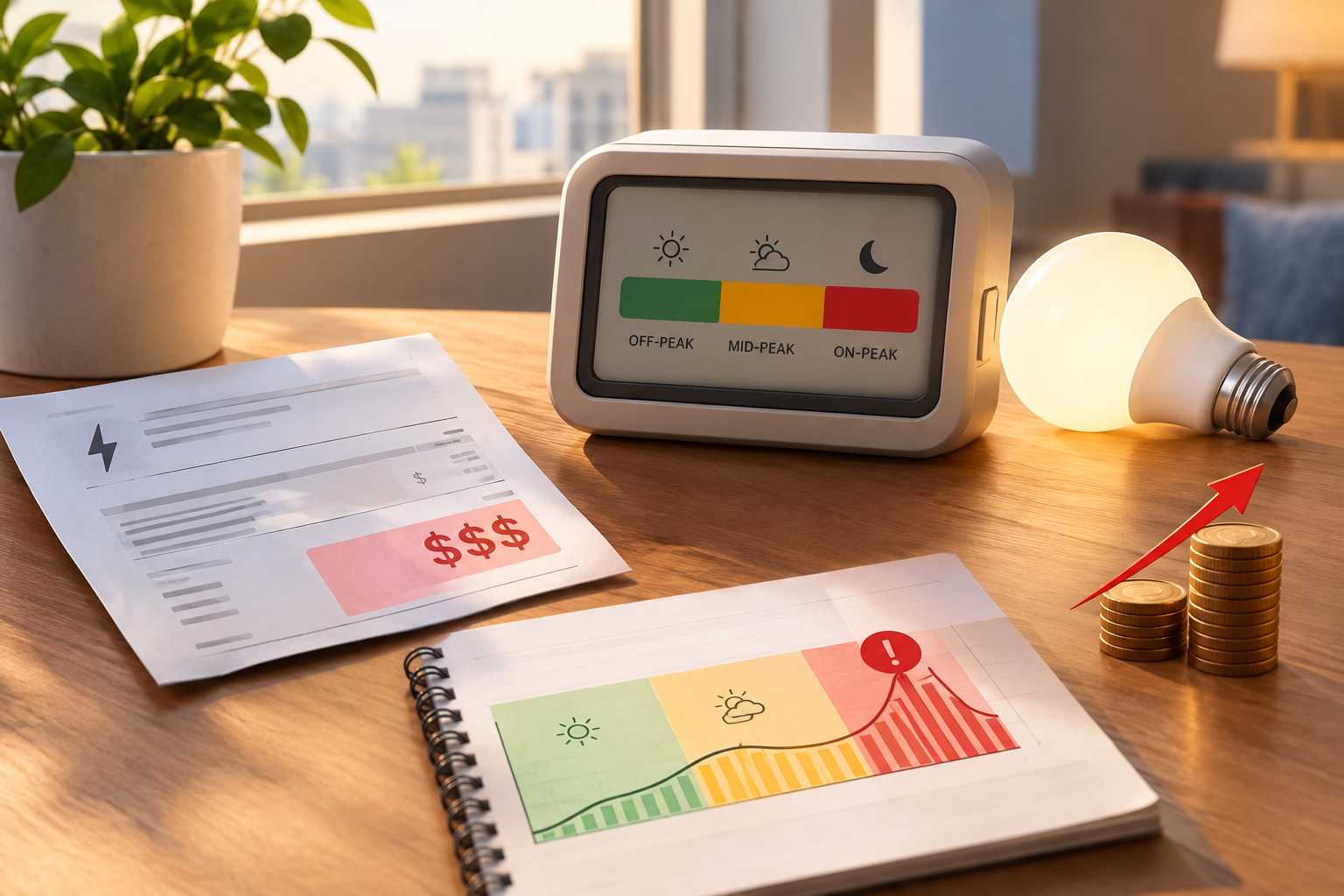
Your bill went up and nothing about your routine changed. No new appliances, no longer showers, no space heater running around the clock. If your utility has moved you onto a time-of-use (TOU) rate structure, the problem might not be how much electricity you’re using. It’s when you’re using it.
TOU billing charges different prices depending on the hour of the day, and it trips people up in predictable ways. Here are the mistakes that actually cost money, and how to stop making them.
TL;DR
- TOU (time-of-use) billing charges different electric rates depending on the hour of day, and it’s set by your utility, not your energy supplier.
- A demand charge is a separate billing mechanism based on your single highest usage spike, not the same as TOU pricing, and the two require different strategies.
- Smart meters make TOU billing possible by tracking interval usage; check your utility portal for your actual hourly data before assuming TOU is the problem.
- New York introduced 2026 legislation specifically to require clearer utility disclosure around smart meter and TOU billing changes.
- Compare electricity rates across suppliers before switching anything, since a supplier switch won’t fix a utility-side TOU issue.
- A fixed rate energy plan keeps your supply charge stable regardless of TOU timing, removing one variable from the equation.
What TOU Billing Actually Means?
Most electric bills work on a flat rate: one price per kilowatt-hour, no matter when you flip the switch. TOU rates break that up into peak, off-peak, and sometimes super off-peak windows, each priced differently. Run your dryer at 5pm instead of 9pm under a TOU plan, and you could pay two or three times more for the same load of laundry.
This isn’t a CPG product. TOU rates are set and administered by your utility, companies like Con Edison, National Grid, PSEG, PECO, or PPL Electric, not by the company that supplies your actual electricity or gas. PPL, for example, has run utility-approved TOU programs in Pennsylvania where participating suppliers offer the rate option, while the utility sets the structure and hours. If your bill mentions TOU, that’s a utility billing decision, not something your supplier chose for you.
Mistake 1: Assuming Your Energy Supplier Sets the TOU Rate.
This is the mix-up at the root of most TOU confusion. People see a higher bill, blame their energy supplier, and switch suppliers expecting it to fix the problem. It won’t, because TOU pricing sits on the delivery side of your bill, the part your utility controls, not the supply side.
If you’re on a fixed rate energy plan for your supply charge, that portion of your bill stays locked regardless of what time you use power. The TOU structure only affects how the utility bills you for delivering that electricity. Knowing which part of your bill is doing what is the first step to actually fixing the cost, not just moving it around.
Mistake 2: Mixing Up TOU Pricing and Demand Charges.
TOU rates and a demand charge sound similar and get lumped together constantly, but they’re calculated completely differently. TOU pricing charges you more per kilowatt-hour during certain windows. A demand charge, by contrast, looks at the single highest spike of power you pulled at once during the billing period, usually measured in kilowatts, and charges you based on that peak moment alone.
Demand charges mostly apply to commercial and small business accounts rather than typical residential customers. But if your business got moved to a rate plan with both TOU and a demand charge stacked on top of each other, shifting your usage to off-peak hours helps with one and does nothing for the other. Running every machine in the building at 6am to beat peak TOU pricing could actually spike your demand charge instead. The two need separate strategies.
Mistake 3: Not Checking What Your Smart Meter Is Actually Tracking.
TOU billing only works because of the smart meter installed at your property. Before smart meters, utilities had no way to know when you used power, only how much. Once a smart meter goes in, your usage gets tracked in intervals, sometimes hourly, sometimes more often, which is what makes time-based pricing possible in the first place.
New York lawmakers introduced legislation in 2026 specifically because this transition confuses customers: utilities would be required to give clear, side-by-side comparisons of pre-smart meter and post-smart meter bills, along with plain-language explanations of TOU pricing changes. That bill exists because people are getting billed differently without being told clearly why. Check your utility’s online portal for your actual interval data. Most show you an hourly or daily usage breakdown once a smart meter is active, and that breakdown is the only way to know if TOU pricing is actually costing you money.
Mistake 4: Skipping the Comparison Before You Commit.
When a TOU rate option shows up, whether from your utility or a supplier, people often just enroll without comparing electric rates against what they’re currently paying. Some households do save money on TOU, particularly ones with flexible schedules who can run high-draw appliances overnight. Others end up paying more every month without realizing it, because their actual usage pattern clusters right in the peak window.
Shopping around matters here too. Suppliers like Constellation, Green Mountain Energy, and Energy Harbor each structure their plans differently, and comparison tools like EnergySage or Clearview Energy can help you see electricity rates side by side before committing to anything. The point isn’t that any one of these is better or worse, it’s that comparing options beats guessing.
Why a Fixed Rate Plan Sidesteps the TOU Guessing Game?
If predicting your peak-hour usage down to the hour sounds like a hassle, you’re not wrong, and that’s exactly why fixed rate energy plans exist on the supply side. A fixed-rate supply charge from CPG doesn’t change no matter when you use power. It won’t go up because you ran the dishwasher at 6pm instead of 10pm.
That doesn’t eliminate your utility’s TOU structure if your delivery charges are billed that way. But it does remove one variable from the equation entirely, so the only thing you’re managing is the utility side, not two moving price structures at once. You can see how CPG’s plans are built on our Why CPG page.
How to Compare Electric Rates the Smart Way?
A few habits make TOU billing far less confusing to manage:
- Pull up your utility’s hourly usage data before assuming TOU is costing you money. The data will tell you plainly.
- Separate your delivery charges from your supply charges on your bill. TOU almost always lives on the delivery side.
- Compare electricity rates across a few suppliers before switching anything, rather than assuming any switch helps.
- Ask your utility directly whether TOU is optional or mandatory for your account type. Many TOU programs are opt-in.
- If you run a small business, ask specifically whether a demand charge applies on top of TOU pricing. They’re billed separately.
If you’ve made small, no-cost changes before, like shifting laundry loads or adjusting thermostat timing, our guide on cutting your electricity bill with smart habits covers more of that ground. And if you’re weighing whether switching suppliers actually helps with any of this, our benefits of switching page breaks down what does and doesn’t change.
Curious whether a fixed rate plan fits your usage pattern? Shop CPG’s energy plans and lock in a rate that doesn’t shift with the clock.
FAQs
If TOU pricing is set by my utility, why does my energy supplier’s website mention it at all?
In some state-approved programs, suppliers choose whether to offer a TOU rate option within rules the utility sets. The utility decides peak and off-peak hours. The supplier can only choose to participate or not:
- Utility: sets hours and structure
- Supplier: opts in or out of offering it
How do I actually find out if I’m on a TOU rate right now?
Check the rate schedule section of your utility bill, not your supplier’s invoice. It will say “time-of-use,” “TOU,” or list separate peak and off-peak kWh charges. If you’re unsure, call your utility directly and ask whether your account is currently billed under a TOU or demand structure.
My business has both a demand charge and TOU pricing. Which one should I focus on fixing first?
Start with demand, since one bad spike can cost more than weeks of peak-hour usage. Look at what’s running simultaneously during your busiest hour and stagger it. Once that spike is under control, shift remaining flexible loads to off-peak windows to chip away at the TOU portion separately.
Does switching to a fixed rate supply plan get rid of TOU charges on my bill?
No, and this is the mistake worth repeating. A fixed rate plan locks your supply charge only. If your utility bills delivery on a TOU structure, that line item stays exactly as the utility sets it, regardless of which supplier you choose or what your supply rate looks like.
Is opting out of TOU billing possible, or am I stuck with it once enrolled?
It depends on your utility and whether the program is mandatory or voluntary for your account type. Historically, utility-run TOU pilots like PPL’s have been opt-in for residential customers. Call your utility and ask directly: mandatory programs and voluntary pilots have different opt-out rules.
Why did my bill change after a smart meter was installed, even though my usage habits didn’t?
A smart meter itself doesn’t change your rate, but it enables your utility to bill based on when you use power instead of just how much. If your utility paired the meter rollout with a new TOU structure, that pairing, not the meter, is what shifted your bill.
Are TOU rates ever cheaper overall, or do they only benefit people with flexible schedules?
They can go either way. Households that can shift laundry, EV charging, or dishwashing to off-peak hours often see savings. Households with fixed routines, like people home and active during peak hours, often end up paying more on TOU than they would on a flat rate.


