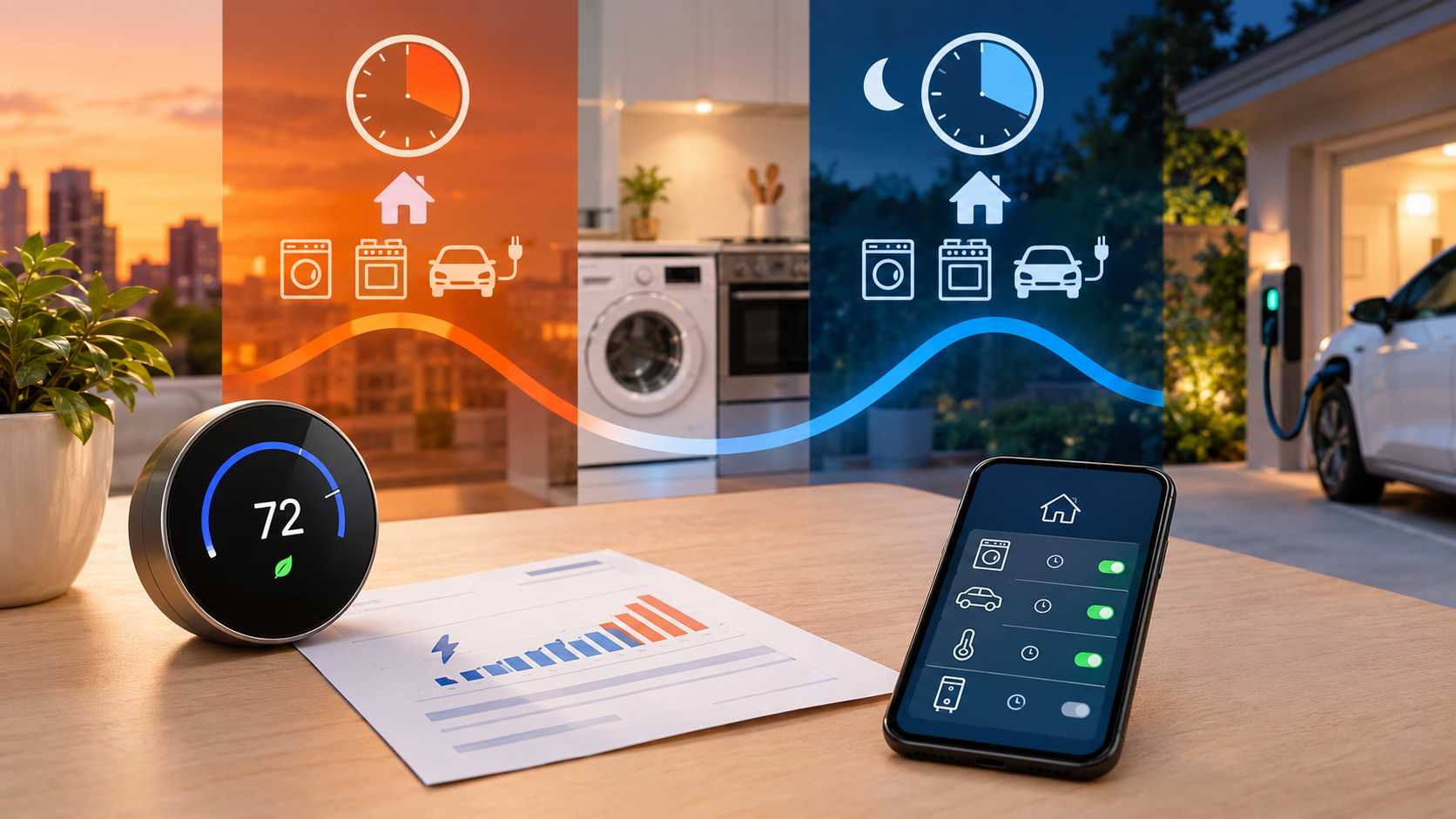
If your electric bill swings from one month to the next a TOU rate structure on your utility’s delivery charges might be the cause. TOU means time‑of‑use. This pricing model charges more for electricity used during hours of the day and less when demand on the grid is low. Once you understand how peak hour pricing works shifting an everyday habits can lower what you pay each month even if your utility has not yet put you on a formal TOU rate.
This guide explains what peak pricing really means, how to check whether it applies to you and the practical steps that reduce your exposure to it. This guide also covers where a fixed rate supply plan fits into the picture because locking in your energy rate is one of the ways to avoid rate volatility.
TL;DR
TOU or time‑of‑use pricing means you pay more for electricity used during hours and less during quiet hours. The rate usually appears on your utility’s delivery charges not on your supply rate.
Check your bill or your utility’s rate schedule, not guesses to confirm whether you are actually on a time‑of‑use electricity rate or a standard flat delivery rate.
A demand charge is a cost that depends on your single highest burst of usage during a billing period. The charge is common on accounts and some larger residential accounts.
Moving laundry, dishwashing, EV charging and HVAC use outside the 4 to 8 p.m. Window is one of the ways to cut peak exposure.
Smart thermostats and smart meter data help you spot and automate these shifts easily.
When you compare rates among suppliers a fixed rate plan protects the supply portion of your bill from market swings even if delivery‑side peak pricing remains variable.
What “Peak Hour” Actually Means on Your Bill?
Electricity is not priced like goods. It must be. Delivered at the same instant it is used and the grid must be built to handle the busiest moment of the year not just an average Tuesday afternoon. When everyone turns on the AC at six p.m. On a July evening power plants that are expensive to run are switched on. The cost of delivering that electricity rises.
It is worth being precise about who charges what. Your utility, such as Con Edison or National Grid in New York or PECO and PPL Electric in Pennsylvania owns the wires and poles. Sets the delivery rate, which is where time‑of‑use electricity rates usually appear. Your energy supplier, like City Power and Gas sets the supply rate, the price of the electricity or gas you use. The two charges are line items on your bill and keeping that distinction clear makes it easier to find where your savings opportunity really lives.
Are You Actually on a TOU Rate? Check Your Delivery Charges First.
Not every household is automatically on a time‑of‑use electricity pricing plan. Many residential customers still pay a delivery rate while TOU plans are often opt‑in, tied to a smart meter rollout or standard for larger commercial accounts. Utilities such as PSEG in parts of the region have also tried time‑of‑use pricing for customers so it is worth checking your own bill or your utility’s rate schedule page instead of assuming either way.
The fastest way to tell is to look for rate tiers listed by time block on your delivery charges or to check whether your account has a smart meter installed. A smart meter records usage in intervals instead of one monthly total, which is what makes hour‑by‑hour pricing possible. If your meter is read once a month you are almost certainly on a standard flat delivery rate.
Why Peak Pricing Looks Different in New York. Pennsylvania?
The two states do not handle peak pricing the way. New York’s grid operator asks utilities like Con Edison and National Grid to manage summer afternoon demand in urban areas, where air conditioning load spikes quickly once temperatures climb. That is why utility‑run demand response programs are more visible in New York City and its suburbs than in most of the state.
Pennsylvania’s peak pattern is more seasonal than hourly with natural gas heating demand driving winter cost spikes across utilities like PECO PPL Electric and other delivery companies in the state. A household in Philadelphia watching for peak pricing usually looks at a calendar than a household in Scranton or Pittsburgh managing summer cooling costs. Either way the fix is the principle: know your utility’s specific rate schedule instead of applying a one‑size‑fits‑all assumption, about when peak actually falls.
The Real Cost Driver: Demand Charges and Peak Pricing.
A second familiar charge appears mainly on commercial and larger residential accounts: the demand charge. While a TOU rate charges more per kilowatt‑hour during hours the demand charge is based on the single highest burst of power that your account pulls during a billing period usually measured in a 15‑minute window. If you run large appliances at once during that window even briefly that single burst can set the demand charge for the entire month.
The U.S. Energy Information Administration tracks how many customers nationwide are enrolled in time‑based rate programs but it does not publish the rates or demand charge amounts. Those amounts vary widely by utility and account type to standardize. That is one reason to pull your own rate schedule directly from your utility rather than relying on a national average.
Six Ways to Shift Usage Out of Peak Windows!
None of these require buying equipment though a few get easier with the right tools.
- Move laundry and dishwashing to the morning or late evening. These are two of the draws in a typical home and both can usually wait a few hours without disrupting your routine.
- Charge electric vehicles overnight. Most electric vehicle chargers can be scheduled, so set a start time after on‑peak hours end of plugging in the moment you get home.
- Pre‑cool or pre‑heat before peak hours start. Running your HVAC system a little harder at 3 p.m. And then easing off during the 4 to 8 p.m. Window keeps your home comfortable without drawing power when it costs the most.
- Batch‑cook. Avoid running the oven during dinner‑hour peaks. A slow cooker or an early start on the stove can take the meal out of the most expensive hour of the day.
- Unplug or schedule pool pumps and other continuous‑draw equipment. These run for hours at a stretch so timing them for off‑peak windows adds up fast over a billing cycle.
- Put your water heater on a timer. Electric water heaters cycle on and off all day to maintain temperature. A simple timer that limits heating to off‑peak hours with a buffer before you typically shower trims one steady draw out of the expensive window.
NYSERDA’s demand response programs go a step further for accounts actually paying customers to cut usage during declared peak events, which gives you a sense of how much utilities value this kind of shifting.
Let Technology Handle the Timing!
A smart thermostat can automate most of the pre‑cooling and pre‑heating strategy above without you having to remember to adjust anything by hand. Look for one that has earned the ENERGY STAR certification because certified models are tested to confirm they actually deliver the energy savings they claim not just the convenience features.
Your smart meter data is worth checking. Most utilities now offer a portal showing hourly or daily usage, which makes it much easier to spot which of your own habits are landing inside peak windows. A handful of households find that a single recurring habit, like running a pool pump all afternoon or doing laundry after work accounts for most of their peak exposure.
Comparing Suppliers Before You Commit!
If you are shopping around you will run into a list of names while you compare electric rates: Constellation and Constellation Energy are among the largest suppliers nationally Green Mountain Energy markets itself on renewable sourcing and regional players like Clearview Energy and Energy Harbor show up often in Pennsylvania searches. Comparison sites such as EnergySage are a starting point for shoppers who want several quotes side by side.
When you compare electricity rates across these options pay attention to whether you’re looking at a fixed or variable structure how long the rate is locked in and whether the plan includes any renewable sourcing you actually care about. A low teaser rate that resets to a price after a few months can end up costing more than a transparent fixed rate from the start.
Why a Fixed Rate Plan Still Beats Chasing Peak Windows?
Shifting your habits helps regardless of your rate type. It will not protect you from a variable supply price that moves with the market. Fixed rate energy plans lock in your supply cost for the length of your contract so if your utility’s delivery‑side TOU pricing or demand charges shift with the seasons the energy portion of your bill stays predictable. City Power and Gas currently offers fixed‑rate electricity and natural gas plans across New York and Pennsylvania including options, for customers who want to pair cost stability with a cleaner energy mix.
Combining two tactics moving usage from busy hours and securing a fixed supply rate—covers both parts of your bill: the delivery charges that your utility manages and the supply rate that your provider sets.
Ready to Lock In a Rate?
Shifting your habits only solves half the equation. Pair them with a fixed rate plan from City Power and Gas and shop plans for your zip code to see rates, for electricity and natural gas across New York.
FAQs
Q: What is a TOU rate, and how is it different from my regular electric bill?
A TOU, or time-of-use, rate charges different prices for electricity depending on the hour it’s used, rather than one flat rate all day. It applies to your utility’s delivery charges. Your supply rate, the price of the electricity itself, is billed separately and isn’t affected by time-of-use pricing.
Q: How do I know if I’m being charged time-of-use electricity rates?
Check your utility bill for rate tiers labeled by time block, such as on-peak and off-peak, listed under the delivery section rather than the supply section. A smart meter installed at your home is also a strong sign, since hour-by-hour billing requires interval data a standard monthly meter can’t provide.
Q: What counts as “peak hours” for electricity pricing in New York and Pennsylvania?
Peak hours typically fall between 4 and 8 p.m. on weekdays, when demand climbs as people get home from work. New York’s peaks are driven mostly by summer air conditioning, while Pennsylvania sees sharper seasonal swings tied to winter heating demand, so check your own utility’s posted schedule.
Q: What’s the difference between a demand charge and a TOU rate?
A TOU rate changes your price per kilowatt-hour based on the time of day. A demand charge is based on the single highest burst of power your account pulls during a billing period, often in a 15-minute window, and appears mainly on commercial or larger accounts.
Q: Can shifting my usage really lower my electric bill?
Yes, especially if you’re on a time-of-use or demand-based rate. Moving laundry, dishwashing, EV charging, and HVAC use outside the 4 to 8 p.m. window reduces the hours you’re billed at the highest price, which adds up noticeably over a full billing cycle and year.
Q: Does a fixed rate energy plan protect me from peak hour pricing?
A fixed rate plan locks in your supply cost, so market swings in the price of electricity itself won’t affect your bill. It doesn’t change your utility’s delivery-side TOU rates or demand charges, so pairing it with usage shifting covers both parts of your bill.
Q: What’s the easiest change I can make today to avoid peak pricing?
Delay your dishwasher, laundry, and EV charging until after 8 p.m. or before your workday starts. These are some of the heaviest, most schedulable loads in a typical home, and shifting just these two or three habits creates an immediate, measurable difference on your bill.
Q: Do smart meters cost extra, or do I need to request one?
Most utilities install smart meters as part of standard grid upgrades at no added cost to you. If your account still shows one monthly reading instead of hourly or daily usage data, contact your utility directly and ask when a smart meter is scheduled for your specific area.