

If you rent in Pennsylvania, there’s a decent chance you’ve never questioned who supplies your electricity. You get a bill, you pay it, and it never crosses your mind that a company besides your local utility might be behind the price you’re paying. But Pennsylvania has been a deregulated energy state since 1999, and a lot of tenants are sitting on a right they don’t know they have.
Here’s the practical version of what matters: whether you can switch energy supplier as a renter comes down to whose name is on the account and how your building is metered. Get those two answers, and everything else falls into place.
TL;DR
- Whether you can switch energy supplier as a PA renter depends on two things: whose name is on the account, and whether your unit is properly metered.
- Your utility, PECO, PPL Electric, or Duquesne Light, always keeps delivering power and handling outages, no matter which supplier you choose.
- Pennsylvania calls competitive suppliers EGS (Electric Generation Supplier), not ESCO like New York.
- Landlords cannot block you from switching if the account is in your name, and retaliation within six months of you exercising that right is presumed illegal.
- If utilities are bundled into rent, the account belongs to your landlord, and the switching decision isn’t yours to make directly.
- A “foreign load” means your meter is measuring more than your own unit, worth checking if you suspect billing issues.
- PAPowerSwitch is the state’s official tool for comparing licensed suppliers in your area.
What “Switch Energy Supplier” Actually Means in PA
Pennsylvania splits electricity into two separate pieces, and understanding the split is the whole key to this topic.
Your utility (PECO, PPL Electric, Duquesne Light, and a handful of others depending on where you live) owns the poles and wires, delivers your power, and responds when the lights go out. That part never changes, no matter what you do.
Your supplier is who generates and prices the electricity itself. In Pennsylvania, this is officially called an Electric Generation Supplier, or EGS, not to be confused with the ESCO terminology used in neighboring states like New York. When you switch energy supplier, you’re only changing this second piece, your utility still handles delivery, billing coordination, and outages exactly as before.
This distinction matters because a lot of tenants assume “switching” means changing which company physically services their apartment. It doesn’t. PECO customers who switch suppliers are still PECO customers for delivery purposes. Same goes for PPL Electric and Duquesne Light territory.
The One Thing That Decides Whether You Can Switch
If the utility account is in your name, meaning you’re the one billed directly, you generally have the legal right to choose your own electric generation supplier. Your landlord cannot block this decision or retaliate against you for making it. Pennsylvania’s Utility Service Tenants Rights Act includes an anti-retaliation provision specifically for this: a landlord raising your rent or attempting eviction within six months of you exercising utility rights is presumed retaliatory under the law.
If your landlord pays the utility directly and bundles the cost into your rent, the account isn’t yours, so you don’t have standing to switch suppliers unilaterally. That decision belongs to whoever holds the account.
There’s a third scenario specific to Pennsylvania worth understanding closely: individual metering.
Individual Metering and “Foreign Load,” Explained
If you’re a tenant responsible for paying your own electric bill, the Pennsylvania Utility Code requires your landlord to ensure your unit is individually metered. That means your meter should measure only what your unit consumes, not shared hallways, not the unit next door, not common-area lighting.
When a tenant’s meter accidentally includes wiring from a common area or a different unit, it’s called a foreign load. If a utility discovers a foreign load issue, they can switch billing responsibility away from the tenant and back onto the landlord until the wiring problem gets corrected, and any resulting debt reverts to the landlord too. This is a protection that doesn’t really have an equivalent in most other states’ tenant-utility frameworks, and it’s worth knowing about even if you’re not currently having billing issues, since older Pennsylvania buildings sometimes have wiring quirks nobody’s checked in decades.
The law also requires that if a landlord splits utility costs among multiple tenants (common in some older multi-unit properties), the split has to be based on something reasonable, like square footage or occupant count, not an arbitrary number the landlord picks.
How to Actually Switch Energy Supplier in Pennsylvania
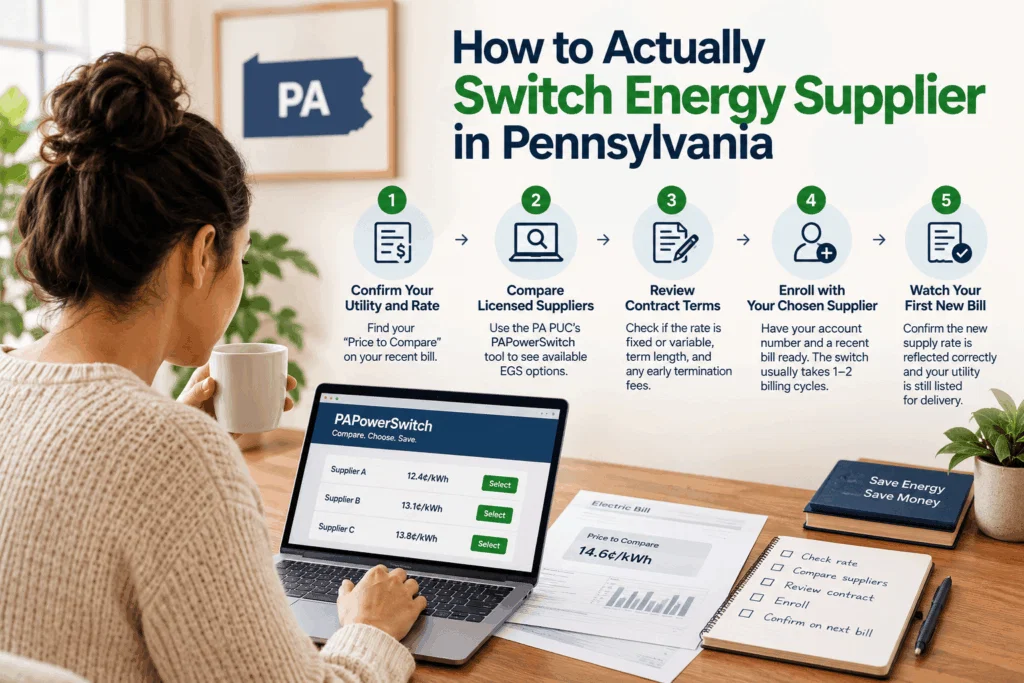
Step 1: Confirm your utility and rate.
Pull a recent bill and find your “Price to Compare,” a number your utility publishes that represents what you’re currently paying for generation. This is your benchmark for shopping. Utilities update this number quarterly, so if your last bill is more than a few months old, it’s worth checking your utility’s website directly for the current figure rather than relying on an outdated statement. Anything you find priced meaningfully below this number is a genuine candidate worth a closer look.
Step 2: Compare licensed suppliers.
The PA PUC’s PAPowerSwitch tool is the state’s official comparison site, and it lists licensed EGS options available in your specific utility territory. Every supplier listed there is required to be licensed by the PA PUC, so you’re not stumbling onto anything unregulated. Enter your zip code and utility name, and you’ll get a filtered list showing rate, contract length, and whether the plan is fixed, variable, or renewable. Take a few minutes to sort by price and skim more than just the top result, since the cheapest listed rate isn’t always the best overall value once contract terms are factored in.
Step 3: Review the contract terms closely.
Look at whether the rate is fixed or variable, the length of the term, and whether an early termination fee applies. Pennsylvania law requires every EGS to provide a Contract Summary disclosure spelling these terms out clearly before you commit, so don’t sign anything until you’ve actually read it, not just the marketing page. Pay particular attention to what happens after the initial term ends. Some suppliers automatically roll customers onto a much higher variable rate once a fixed-term contract expires, and that’s often where renters get caught off guard months down the line.
Step 4: Enroll with your chosen supplier.
You’ll typically need your account number and a recent bill on hand. Enrollment can usually be completed online or by phone directly with the supplier, and most confirm your enrollment by email within a day or two. The switch usually takes one to two billing cycles to fully take effect, so don’t be alarmed if your very next bill still reflects your old rate, that’s normal and expected during the transition window.
Step 5: Watch your first new bill closely.
Confirm the new supply rate is reflected correctly, and that your utility, PECO, PPL Electric, or Duquesne Light, is still listed for delivery as expected. If the rate doesn’t match what you signed up for, contact your new supplier directly before the next billing cycle, since catching a billing error early is far easier to resolve than trying to fix it after several months have passed.
PECO, PPL Electric, and Duquesne Light: What Changes and What Doesn’t
A lot of renters in Philadelphia assume PECO is their only option since it’s the name on every bill. Renters in central and eastern PA see the same assumption with PPL Electric, and Pittsburgh-area tenants with Duquesne Light. None of that assumption is accurate once you understand the utility-versus-supplier split.
PECO remains your delivery utility no matter which EGS you choose. If there’s an outage, you’re still calling PECO, not your supplier.
PPL Electric works identically, it delivers power and manages your account’s utility side regardless of who supplies your electricity.
Duquesne Light functions the same way for customers in its western Pennsylvania territory.
In all three cases, switching suppliers is a pricing decision, not a service-provider change. Your meter doesn’t get swapped. No technician visits your unit. The only thing that changes is which company’s rate shows up on the generation portion of your monthly bill.
Comparing Electric Rates the Right Way
When you compare electric rates between suppliers, don’t just look at the headline number. A few things matter more than the sticker price:
- Fixed vs. variable. A fixed rate holds steady for your contract term. A variable rate can move month to month, sometimes sharply, based on market conditions.
- Length of term. Shorter terms give you more flexibility if you’re renting short-term or expect to move.
- Early termination fees. Some contracts charge a fee if you cancel before the term ends, worth knowing upfront if your lease is month-to-month.
- Renewable options. Some EGS providers offer green energy blends at a modest premium, worth considering if that matters to you.
If you’ve already read our guide on how renters in New York can switch energy suppliers, you’ll notice the core logic (whose name is on the account) holds in both states, even though the specific laws, terminology, and utility names are different. Pennsylvania’s EGS system and New York’s ESCO system both grew out of the same wave of 1990s-era energy deregulation, just with state-specific rules layered on top.
Conclusion
Whether you can switch energy supplier as a Pennsylvania renter comes down to two questions: is the account in your name, and is your unit properly, individually metered. If both check out, the process itself is quick, doesn’t touch your actual electric service, and can be done directly through PA’s official PAPowerSwitch comparison tool or through a licensed supplier directly.
Before you commit to any plan, it’s worth understanding how a licensed energy supplier differs from a less reputable one, since the difference often comes down to contract terms buried in fine print rather than anything obvious upfront. And if you’re comparing options across suppliers, our guide to comparing electric rates walks through what actually matters beyond the headline number. For the full list of PUC-licensed suppliers currently serving your area.
FAQs
How do I change my electric supplier in Pennsylvania?
If you are eligible for energy choice, you can select a competitive electricity supplier instead of purchasing your electricity supply from your utility’s default service.
The general process is:
- Check your current electricity supply rate.
- Compare available supplier offers for your utility service area.
- Review whether the rate is fixed or variable.
- Check the contract length and any cancellation fees.
- Enroll with the supplier you choose.
Your local utility will continue to deliver electricity to your home, maintain the distribution system, and handle power outages.
How do I switch back to PPL Electric as my supplier?
If you currently receive your electricity supply from a competitive supplier and want to return to PPL Electric’s default supply service, first check the terms of your current supplier agreement.
You should look at:
- Your contract end date
- Any early termination fee
- Your current supply rate
- PPL Electric’s applicable default service rate
The change concerns the electricity supply portion of your bill. PPL Electric continues to deliver electricity to your property regardless of which supplier provides your generation service.
How do I switch back to PECO for my electricity?
If you want to return to PECO’s default electricity supply service, check your current competitive supplier agreement before making the change.
Pay attention to:
- Contract expiration date
- Early termination charges
- Current supplier rate
- PECO’s applicable default service rate
Changing your electricity supplier does not change your physical electric service. PECO continues to deliver electricity through its distribution system and handles outages.
Can renters choose their own electricity supplier in Pennsylvania?
Yes, eligible renters can generally choose a competitive electricity supplier when the electricity account is in their name.
Your ability to switch depends largely on who controls the utility account:
- Account in your name: You may generally choose an eligible supplier.
- Account in your landlord’s name: You generally cannot change the supplier yourself.
- Electricity included in rent: Check your lease to understand how electricity is billed.
Before switching, renters should also check their lease and supplier contract, particularly if they expect to move before the contract ends.
What is the best electricity plan for apartments and renters in Philadelphia, PA?
There isn’t one electricity plan that is best for every Philadelphia renter. The right option depends on your electricity usage, available rates, contract terms, and how long you expect to remain in the apartment.
When comparing plans, check:
- Price per kWh
- Fixed or variable rate
- Contract length
- Early termination fee
- Promotional rate and expiration date
- Any additional charges
For renters, contract flexibility can be especially important because a low rate may not provide savings if moving early results in a cancellation fee.
Does switching electricity suppliers change my utility or electricity delivery?
No. Switching suppliers changes the company providing your electricity supply, not the utility responsible for delivering electricity to your home.
Your local utility continues to:
- Deliver electricity through its distribution network
- Maintain power lines and related infrastructure
- Respond to outages
- Maintain your physical connection to the electric grid
The supplier and utility perform different roles, so changing suppliers does not require new wiring or a different physical electricity connection.
Can I switch my gas and electric company at the same time in Pennsylvania?
Potentially, but electricity and natural gas are separate services. Whether you can switch both depends on your utility accounts and the competitive supplier options available for each service.
For example, you may need to compare:
- Your electricity supplier options
- Your natural gas supplier options
- Separate rates and contract terms
- Separate cancellation or termination fees
Changing your electricity supplier does not automatically change your natural gas supplier. Each service should be reviewed separately before enrolling.
What happens if I switch electricity suppliers but later want to change again?
You can generally choose another supplier when you are eligible to switch, but you should check your current agreement before making another change.
Look for:
- Contract expiration date
- Early termination fee
- Fixed or variable pricing
- Renewal terms
- Any conditions for switching before the contract ends
Your local utility continues delivering electricity throughout the process, so changing suppliers does not require you to change your physical electric service.
What if my rent already includes electricity?
If electricity is included in your rent, the utility account may be controlled by your landlord rather than you. In that situation, you generally cannot choose the electricity supplier directly.
Check:
- Your lease agreement
- Who is listed as the utility account holder
- Whether electricity is included in your rent
- How your landlord calculates or charges for electricity
If you want more control over your electricity supplier, ask your landlord whether the account can be placed in your name or whether the property is eligible for individual supplier choice.
How long does it take to switch electricity suppliers in Pennsylvania?
A supplier change generally does not take effect immediately. After you enroll, the new supplier’s service typically begins according to the applicable utility and billing schedule.
During the transition:
- Your electricity supply continues normally.
- Your local utility continues delivering electricity.
- You do not need to arrange a new physical connection.
- The supplier change will appear according to the applicable billing cycle.
The exact timing can vary by utility, enrollment date, and supplier, so check your enrollment confirmation for the expected effective date.


