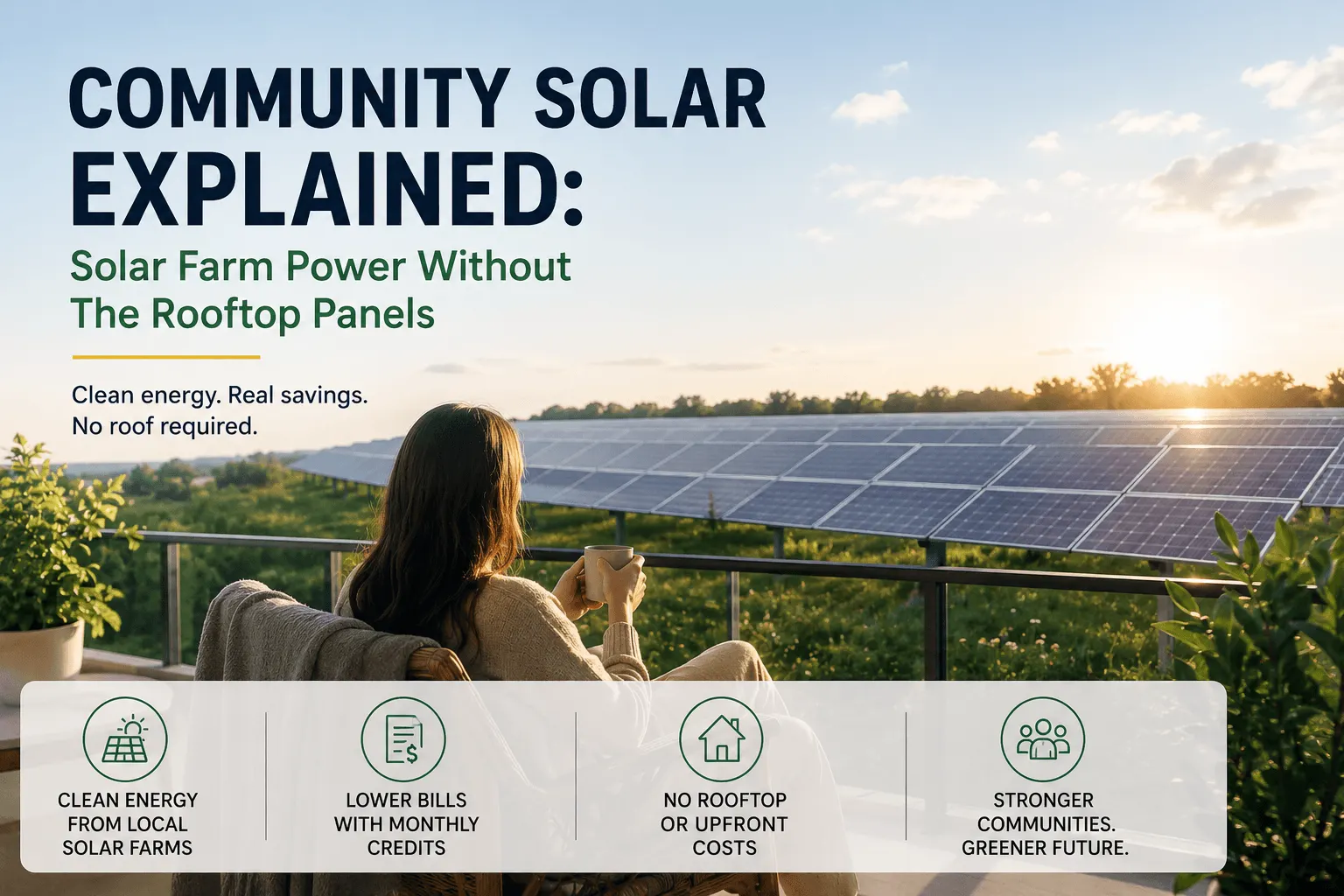
Anyone who’s priced out rooftop solar knows the usual roadblocks. You rent. Your roof faces north. Or the quote you got back had so many zeros in it that you closed the tab and didn’t think about it again. A full home solar install in New York often runs into the tens of thousands of dollars once permits, equipment, and labor are added up, and that’s before anyone talks about whether your roof can even support panels.
Community solar sidesteps most of that. You sign up for a share of a solar farm built somewhere else, usually a few miles from your house, and your utility bill gets a credit for the power that share produces. There’s no install, no roof requirement, and in most programs, no money down. Here’s what’s actually involved, and how to tell if it makes sense for you.
TL;DR
- You subscribe to part of an offsite solar farm and get a credit on your electric bill. Nothing gets installed at your home.
- Your utility, whether that’s Con Edison, National Grid, or another provider, still delivers your power exactly as before. Community solar is a bill credit layered on top, not a replacement for your utility.
- New York has more than 1,300 community solar projects operating statewide, more than any other state in the country, according to NYSERDA.
- Renters, condo owners, and anyone with a shaded or badly angled roof can still take part.
- Savings typically land somewhere between 5% and 15% off your electric costs, once you subtract the subscription fee from the credit you receive.
- Renewable energy certificates (RECs) track and verify clean generation across the grid. They’re related to community solar but not the same thing.
- Lower-income New Yorkers may qualify for bigger discounts through the state’s Solar for All program.
- Get the savings percentage and cancellation terms in writing before you sign anything.
What community solar actually is?
Picture a solar farm as a shared power plant rather than a private one. Instead of a homeowner putting a handful of panels on their own roof, a developer builds a much larger array on a stretch of unused land, a landfill, or a warehouse roof, and then sells subscriptions to the surrounding households and small businesses.
You don’t own any part of the equipment. You’re subscribing to a portion of what the farm generates, and that portion shows up as a line-item credit on your regular electric bill. The electricity you actually use still travels through the grid the same way it always has, delivered by your existing utility. The credit is a financial arrangement, not a change in where your electrons physically come from.
New York has pushed this model harder than most states. As of March 2025, the state had more than 1,300 active community solar projects, giving it the largest amount of community solar capacity in the country, per NYSERDA’s own data. If you’ve been wondering whether this is some small pilot program, in New York it’s already mainstream.
lar programs are common or some kind of pilot project, in New York they’re mainstream at this point.
How Community Solar Programs Actually Work, Step by Step?
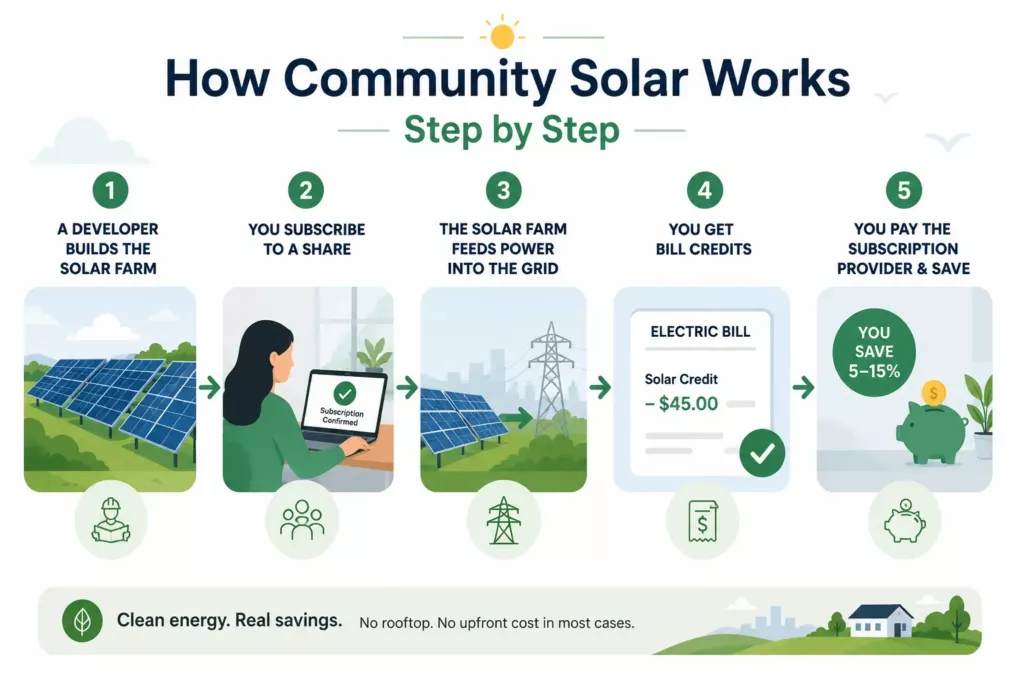
A developer, sometimes a private solar company, sometimes working alongside a utility, builds the array first. Once it’s up and running, households and businesses in that utility’s service area can sign up for a share, usually sized to roughly match how much electricity they use in a typical month.
You don’t get equipment delivered, and in most cases nobody shows up at your house at all. The power the farm generates goes straight into the shared grid, the same as electricity from any other source. Your utility keeps track of your subscription share and applies a credit to your monthly bill based on how much your portion of the farm produced.
You pay the solar provider a separate subscription fee, and that fee is set lower than the value of the credit you get back. NYSERDA’s breakdown of how community solar works describes this same basic structure: customers receive monthly bill credits for their share of what the project generates, and most programs don’t require buying any physical equipment at all. Con Edison reported that community solar customers in its territory earned $43.7 million in credits in just the first half of 2025, and about 55,000 households saw their bill drop to zero at least once during that stretch, based on the company’s own mid-2025 figures.
Solar farm subscription vs panels on your own roof
Community solar isn’t automatically the better option. It solves a different problem than rooftop panels do.
Owning panels outright, whether you pay cash or finance them, tends to produce bigger savings if you’re staying in the home for a long stretch. But it comes with real upfront cost, a roof that has to face the right direction, and upkeep on your end, including regular cleaning, since dust and debris buildup can quietly cut into a panel’s output over time.
A community solar subscription trades some of that long-term ceiling for accessibility. There’s no ownership requirement, no roof orientation to worry about, and no maintenance on your part, since that’s the solar farm operator’s job. If you rent, live in a condo building, or have a roof that just doesn’t work for panels, it’s often the only practical way to get in on renewable power at all.
Where renewable energy certificates fit in?
You’ll often see community solar mentioned alongside renewable energy certificates, or RECs, and it’s worth knowing the difference since the two get confused a lot.
According to the EPA, a REC is a market-based instrument representing the environmental attributes of one megawatt-hour of renewable electricity generated and delivered to the grid. RECs can be bought and sold on their own, separate from the actual electricity, which is how some green power programs let customers claim renewable usage without subscribing to a specific solar project.
Community solar and RECs cover overlapping but different ground. Your subscription ties you to a direct bill credit from one specific project’s output. RECs work more like an accounting and verification layer across the broader energy market, tracking generation so it isn’t claimed twice. If you’re trying to confirm that a green energy claim is actually legitimate, third-party certification through a program like Green-e Energy is part of how the industry checks that.
Who can actually sign up in New York?
Eligibility is wider than most people expect. Homeowners, renters, businesses, and multifamily buildings can all participate, and there’s no requirement to own property or live in any particular type of housing, according to NYSERDA.
A few practical notes:
- You’ll need an active utility account in your own name, within your utility’s service area.
- Your subscription is tied to your specific utility’s billing system, so it generally has to stay within that same territory.
- Income-eligible programs exist. New York’s Solar for All initiative offers larger bill credits for households that qualify.
- Long-term lock-in is uncommon, though terms vary by provider, so read the agreement before signing.
What to check before you sign anything?
Not every community solar program is set up the same way, and a bit of homework upfront saves headaches down the line.
Get the savings percentage in writing. Providers often advertise a range during a sales pitch, but the number that actually applies to your account should be spelled out in the subscription agreement itself.
Ask what happens if you cancel. Some programs let you walk away anytime with no penalty. Others have minimum terms. If you’re likely to move within the same utility territory, this matters less. If you might leave the area entirely, check the exit terms before you sign.
Be wary of pushy sales tactics. Community solar has grown fast enough in New York that it’s picked up its share of aggressive door-to-door and phone marketing. A legitimate provider won’t pressure you to sign on the spot, and you should never hand over your utility account number to a marketer before you’ve decided to enroll.
Confirm the provider actually coordinates with your utility. National Grid’s own guidance walks through this step directly: find a provider, contact them, and go through a credit check and signed agreement before anything shows up on your bill. If a company can’t clearly explain how its credits will appear on your actual statement, that’s worth pausing on.n’t clearly explain how their credits show up on your actual bill, that’s worth pausing on.
Is Community Solar Worth It?
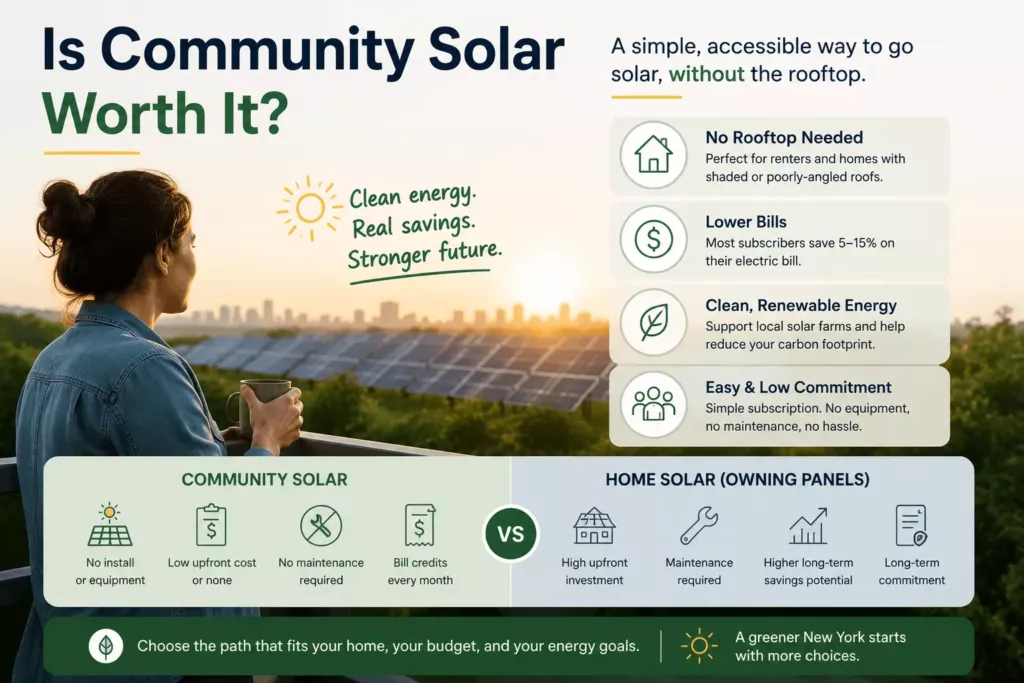
For renters, for homeowners stuck with a shaded or poorly oriented roof, and for anyone who doesn’t want to deal with the cost and commitment of a full rooftop install, community solar solves a real access problem. It won’t get you the maximum possible long-term payoff the way owning panels outright can, but it’s a low-effort way to get renewable power reflected directly on your bill.
If you want to compare offers or see what’s actually available near you, NYSERDA’s project finder lets you search by utility territory and zip code, and both Con Edison and National Grid publish their own program details for customers in their territory.
FAQs
Do I need to switch utilities to join community solar?
No. Your delivery utility, whether that’s Con Edison, National Grid, or someone else, stays exactly the same. Community solar adds a credit on top of your existing service, it doesn’t replace it.
Is there really no upfront cost?
Most subscriptions in New York don’t require any payment upfront or any equipment purchase. You pay a monthly subscription fee that’s set below the value of the credit you get back, so the net effect is savings rather than a new expense.
What happens if I move?
It depends on the provider and whether your new address falls within the same utility territory. Some subscriptions transfer, others don’t. Ask directly before you sign.
Can I combine community solar with a competitive energy supplier?
Usually, yes. Your community solar subscription and your choice of electricity supplier are generally independent decisions, though it’s worth confirming with your specific provider since the rules vary.
Am I buying solar panels for someone else’s farm?
No. You’re not purchasing equipment or any ownership stake. You’re subscribing to a share of the electricity a solar farm produces and getting bill credits in return. The panels stay owned by the project developer.
Does this work if I live in an apartment?
Yes. Renters and multifamily buildings both qualify, as long as you have an active utility account in your own name within the project’s service area.
How much can I realistically expect to save?
Most New York programs land somewhere in the 5% to 15% range, though the exact number depends on your provider and agreement.
Can I switch providers if I’m not happy with mine?
Usually. Some providers let you switch anytime with no penalty, others require notice or have a minimum term, so check your agreement first.