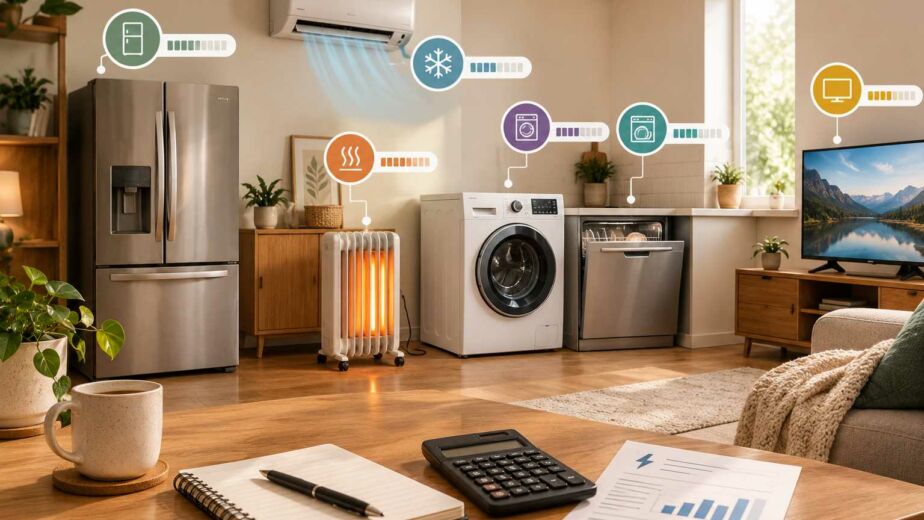
You’ve got the keys. The lease is signed, the security deposit cleared, and somewhere in a stack of boxes is a lamp you’re going to need tonight. Then it hits you: does the apartment even have power right now? Whose name needs to be on the account? Is there a deadline you’re already missing without knowing it?
If you’re building a first apartment checklist and utilities feel like the part nobody explained clearly, you’re not alone. Most guides built for moving into an apartment for the first time spend paragraphs on cardboard boxes and two sentences on the thing that actually determines whether your lights turn on. This one flips that ratio, and treats your utility setup checklist as its own priority, not a footnote.
Whether you call it a move in checklist for renters, an apartment checklist for first apartment living, or just “the stuff I need to handle before I unpack,” the logic underneath is the same: get your energy account sorted before anything else, and the rest of the move gets a lot less stressful.
TL;DR
- A first apartment checklist should treat utility setup as a priority task, not a footnote, since power almost never transfers automatically between tenants.
- Confirm your delivery utility first: Con Edison or National Grid in New York, PECO, PPL Electric, or Duquesne Light in Pennsylvania.
- Contact your utility 3 to 5 business days before move-in, online or by phone.
- Choosing an electricity supplier is separate from setting up delivery, and it’s optional on day one.
- Review your first bill closely, prorated charges and deposits are normal, not errors.
- Set a reminder to revisit your rate after two or three months of real usage history.
- The process is nearly identical in NY and PA, only the utility names and specific rules differ.
Why Every First Apartment Checklist Needs a Real Utility Setup Checklist
Here’s the part that catches first-time renters off guard: utilities almost never transfer automatically when you move into a new apartment. Even if the previous tenant had power running through the exact same wires you’re about to use, the account is tied to their name, not yours. Show up on move-in day without calling ahead, and there’s a real chance you’re standing in a dark apartment, calling a utility’s after-hours line while your movers wait outside with a couch. It’s one of the most common surprises for anyone moving into an apartment for the first time.
This is exactly why a proper utility setup checklist deserves its own dedicated slot on any apartment checklist for first apartment renters, not something buried under “misc.” It needs a phone call, or a few clicks online, days before you show up with boxes. Treat it as one of the non-negotiable first apartment essentials checklist items, right alongside getting your keys and confirming your move-in date.
What Belongs on Your Moving Into Your First Apartment Checklist
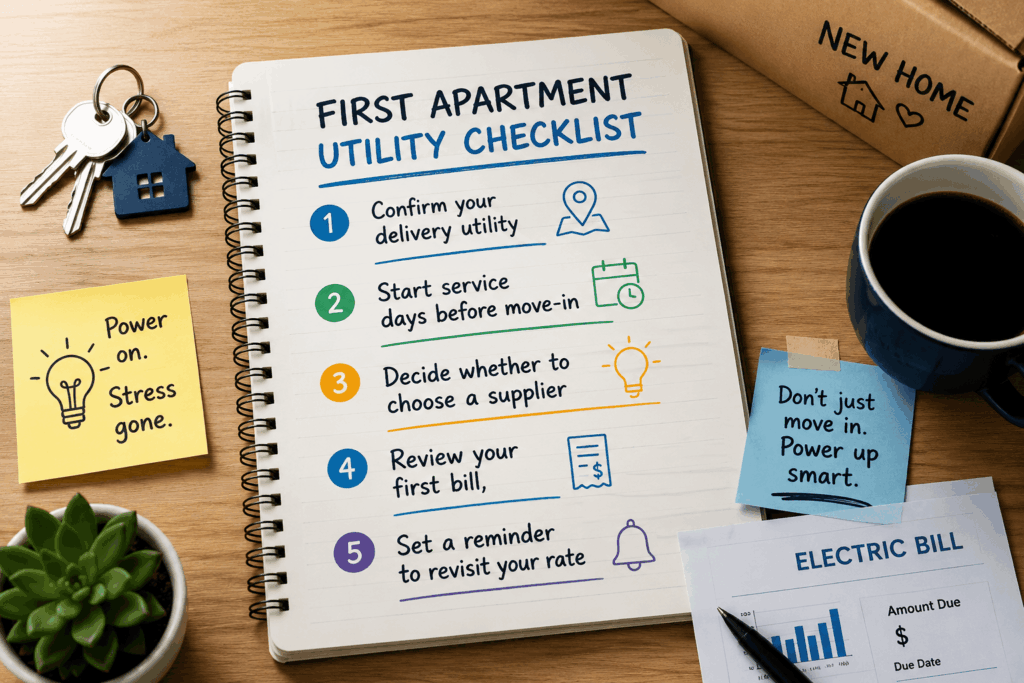
Before you even think about paint colors or where the couch goes, a solid moving into your first apartment checklist should include the following, in this order:
- Confirm your delivery utility based on your address.
- Start service several business days before move-in.
- Decide whether you’re also shopping for a supplier.
- Review your first bill line by line.
- Set a reminder to revisit your rate later.
That’s the backbone of a real moving into first apartment checklist. Everything below walks through each step in more depth, so you’re not just checking boxes blindly. If you’ve searched around for a moving into first apartment checklist before and found generic advice about packing tape and forwarding your mail, this is the version that actually covers the part that keeps your lights on.
Step 1: Confirm Who Handles Delivery in Your Area
Before anything else, figure out which utility actually serves your building. This part isn’t optional and it isn’t something you get to choose, it’s determined entirely by your address.
If you’re in New York, you’re most likely dealing with Con Edison (NYC and Westchester) or National Grid (much of upstate and Long Island). If you’re in Pennsylvania, it’s typically PECO (Philadelphia area), PPL Electric (central and eastern PA), or Duquesne Light (Pittsburgh area).
Con Edison customers can start, stop, or transfer service directly online in a matter of minutes. National Grid offers a similar online start service portal for New York customers, though upstate accounts sometimes require a scheduled technician visit rather than an instant activation. Over in Pennsylvania, PECO’s new customer page walks new residents through the same process, and PPL Electric utilities and Duquesne Light both offer comparable online setup for their respective territories. If you’re unsure which of the PPL Electric utilities coverage areas your new address falls under, your lease paperwork or landlord can usually confirm it in a minute.
Step 2: Call or Go Online, Days Before Move-In
Don’t wait until move-in day. Most utilities recommend starting the process at least a few business days ahead, and some, particularly National Grid in upstate New York, require even more lead time if a technician needs to physically activate your meter.
Here’s what you’ll typically need on hand:
- Your new address, unit number included
- Your move-in date
- A government-issued ID
- Sometimes a deposit, particularly if this is your first time opening an account and you don’t have an established credit or rental history with that utility
Con Edison, National Grid, PECO, PPL Electric, and Duquesne Light all offer online account setup, which is usually faster than calling, though phone support is worth using if your situation is anything but standard, subletting, a roommate splitting the account, or a building with shared metering.
Step 3: Decide Whether You’re Also Choosing a Supplier
This is the step a lot of renters working through their first apartment checklist don’t even realize exists. Setting up your utility account covers delivery, the actual poles, wires, and infrastructure that get power to your unit. But in both New York and Pennsylvania, you also get to choose who supplies and prices your electricity, separately from delivery.
You’re never required to shop for a supplier on day one. Your utility will assign you a standard default rate automatically if you don’t choose anything, and plenty of renters stick with that indefinitely without issue. But if saving money matters to you from the start, it’s worth at least glancing at your options before you settle into a routine of not thinking about it.
If this is new territory for you, our guide on how to choose a licensed energy supplier walks through what separates a legitimate offer from a sketchy one, worth a read before committing to anything.
Step 4: Understand What’s Actually on Your First Bill
Your first bill after setup can look more complicated than expected, sometimes it includes a prorated partial month, a deposit charge, or fees you didn’t anticipate. None of that is unusual, but it helps to know what you’re looking at instead of panicking over an unfamiliar number.
If a bill ever seems off, understanding the anatomy of a utility bill in general (not just the total due, but the individual line items) makes it much easier to catch an actual error versus a normal first-bill quirk. It’s worth taking five minutes with your first statement rather than paying it on autopilot, especially since this is likely your first time managing an account entirely on your own.
Step 5: Set a Reminder to Actually Look at Your Rate Later
A lot of first apartment essentials checklists stop at “get the power turned on.” But energy setup isn’t really finished the day service starts, it’s finished once you’ve made an informed choice about what you’re paying, even if that choice is “I’m fine with the default for now.”
Set a calendar reminder for two or three months out. By then you’ll have a real bill history to look at, and you’ll actually know what your typical usage looks like instead of guessing. That’s a much better moment to compare rates than move-in week, when you’re mentally juggling forty other things at once. Most lists of first apartment essentials focus on furniture and kitchenware, but a rate check belongs on that list just as much as a shower curtain does.
A Few Things That Trip Up First-Time Renters Specifically
Anyone moving into an apartment for the first time tends to hit the same handful of snags. Here’s what to watch for before they catch you off guard.
Assuming the apartment already has power. Unless your landlord explicitly told you utilities stay on between tenants, treat every new apartment as a fresh setup, not a continuation of the last tenant’s account.
Forgetting the account has to match the lease name. If your name isn’t on the lease, some utilities will still let you open an account, but it’s worth confirming rather than assuming, especially in roommate situations.
Overlooking the deposit question. First-time account holders sometimes get asked for a security deposit, refundable after a set period of on-time payments. It’s not a scam or a bad sign, it’s standard for anyone without an existing account history with that particular utility.
Not asking about paperless billing and autopay early. Setting these up at account creation, rather than months later, saves you from ever having a late payment simply because a paper bill got buried under moving boxes.
Assuming your roommate’s name on the account covers you too. If a roommate is the one who set up service and their name is the only one on file, you may have no direct standing to request changes, dispute a charge, or even get basic account information from the utility.
Not budgeting for seasonal swings. Your first bill in a mild month can be misleadingly low. A first-time renter who anchors their expectations to a comfortable spring bill can be genuinely startled by what shows up in the peak of summer or winter.
What This Looks Like in Practice: NY vs. PA

The steps themselves don’t change much between the two states, but the actual utility names and contact points do, so here’s a quick reference for anyone finalizing their apartment checklist for first apartment living in either state.
New York renters dealing with Con Edison or National Grid can set up new service largely online, and both utilities typically process a standard residential move-in request within a few business days once submitted with complete information.
Pennsylvania renters working with PECO, PPL Electric, or Duquesne Light follow a similar process, and since Pennsylvania is a deregulated market, this is also the point where you’ll first see the option to shop supplier rates if you want to.
One more distinction worth knowing: both states let you choose your electricity supplier separately from your delivery utility, but the account setup step itself is identical either way. You’re always opening an account with your delivery utility first, whether that’s Con Edison, National Grid, PECO, PPL Electric, or Duquesne Light. Supplier shopping is a decision you layer on top, whenever you’re ready for it, not a prerequisite to getting your lights turned on.
Beyond Energy: The Rest of Your Move-In Checklist
Energy setup is the piece most guides underexplain, but it’s not the only account that needs your new address on file before or right after you move into a new apartment. The official USA.gov moving guide is a solid reference for the broader change-of-address process, mail forwarding, government records, and everything outside your utility accounts.
And if energy efficiency is something you want to think about from day one in your new place rather than after your first summer bill shocks you, our roundup of practical energy-saving tips is worth bookmarking for once the boxes are unpacked.
Conclusion
A first apartment checklist that treats energy setup as an afterthought is setting you up for a stressful move-in day. Confirm your utility, whether that’s Con Edison, National Grid, PECO, PPL Electric, or Duquesne Light, reach out before you arrive with boxes, decide loosely whether you want to shop your supplier now or later, and actually look at that first bill instead of filing it away unread.
None of this takes more than an hour spread across a few days, and it’s the difference between walking into a lit apartment on move-in day or standing in the dark wondering what went wrong. Whether you found your way here searching for a moving into your first apartment checklist, a straightforward moving into first apartment checklist, an essentials for first apartment list, or a move in checklist for renters, the underlying process is the same. Confirm your utility, reach out with enough lead time, and decide on a supplier once you’re ready.
Print this out, treat it as your essentials for first apartment planning, and you’ll be one of the rare first-time renters who has this part handled before the moving truck even shows up. A little planning now turns what could be a stressful first apartment essentials checklist scramble into a quick, forgettable errand, and it’s the one line on any apartment checklist for first apartment living that actually determines whether the rest of moving day goes smoothly.
FAQs
How do I set up electricity for a new apartment?
Start by checking your lease to determine whether electricity is your responsibility. If you are responsible for the electric account, identify the utility serving your new address and arrange service for your move-in date.
Before setting up service:
- Confirm which utility serves the apartment.
- Check whether electricity is included in your rent.
- Have your new address and move-in date ready.
- Ask whether you can choose an electricity supplier.
- Review any deposit or account setup requirements.
If your area has a competitive electricity market, setting up delivery service and choosing an electricity supplier may be two separate steps.
How do I set up electricity when moving to a new apartment in New York?
First, identify the utility that serves your new apartment. The utility depends on your location, so the company serving your current home may not be the same one serving your new address.
Once you identify the utility:
- Arrange electricity service for your move-in date.
- Provide the information required to establish the account.
- Check whether the address allows electricity supplier choice.
- Compare available supply plans if you want to choose an ESCO.
- Review the supplier’s rate and contract terms before enrolling.
Your local utility remains responsible for delivering electricity to the apartment even if you choose a competitive supplier.
When should I set up electricity for my new apartment?
It’s best to arrange electricity before moving day. Waiting until the day you move can create problems if the account requires additional verification, a deposit, or other setup steps.
A practical approach is to:
- Confirm the utility as soon as you have the new address.
- Arrange service before your move-in date.
- Request your intended start date.
- Keep your confirmation details until the account is active.
If your apartment requires electricity for heating, cooling, or other essential systems, setting up service ahead of time is particularly important.
Can I schedule electricity to start on my move-in date?
Yes. When establishing service, you can generally request a specific start date, including your scheduled move-in date.
Provide the utility with:
- Your new apartment address
- Your requested service start date
- The information needed to establish the account
- Any additional details requested by the utility
The exact process can vary by utility, so confirm the effective date after completing the setup.
What is the first step when setting up utilities for an apartment?
The first step is to check your lease and identify which utilities you are responsible for. Not every apartment requires the renter to establish every utility account.
For electricity, determine:
- Whether electricity is included in rent
- Whether the account must be in your name
- Which utility serves the address
- Whether you can choose an electricity supplier
Once these details are clear, you can arrange electricity service for your move-in date.
Do I need to set up electricity if I’m renting an apartment?
You generally need to establish an electricity account if your lease makes you responsible for the electric bill.
You may not need to do so if:
- Electricity is included in your rent.
- Your landlord maintains the utility account.
- The property uses a billing arrangement where electricity is handled by the property owner.
Check your lease or ask your landlord or property manager before contacting the utility. This prevents you from opening an account when the property owner is actually responsible for the service.
What information do I need to set up electricity in an apartment?
The exact requirements vary by utility, but you should have basic information about your move and new residence ready.
This may include:
- Your full apartment address
- Apartment or unit number
- Service start date
- Contact information
- Identification or account verification information
- Payment or deposit information, if required
Having these details ready can make the account setup process faster and reduce delays before your move-in date.
How far ahead should I set up electricity before moving?
Set up electricity as early as practical once your move-in date is confirmed. There is no single nationwide deadline because each utility has its own account setup and service procedures.
Arranging it ahead of time gives you room to handle issues such as:
- Account verification
- Required deposits
- Service scheduling
- Meter-related requirements
- Incorrect address information
Avoid waiting until moving day, particularly if you are moving into a property where electricity has been disconnected.
Is choosing an electricity supplier part of setting up utilities for a new apartment?
Not always. Electricity delivery and electricity supply can be separate services in areas with competitive energy markets.
The local utility generally handles delivery, while an eligible customer may be able to choose a competitive supplier for the supply portion.
You can therefore:
- Establish utility delivery service.
- Remain on the utility’s default supply service, where applicable.
- Compare competitive suppliers separately if supplier choice is available.
Choosing a supplier is an option in eligible markets, not a requirement for every apartment.
Can I choose my electricity supplier when moving into a new apartment?
You may be able to if your new apartment is located in a market that allows residential electricity supplier choice and you are eligible to participate.
Before choosing a supplier, compare:
- Electricity rate per kWh
- Fixed versus variable pricing
- Contract length
- Early termination fees
- Promotional pricing
- Terms that apply after an introductory period
Your local utility will generally continue delivering electricity and handling outages regardless of which eligible supplier you select.
What is the difference between an electricity utility and an electricity supplier?
The utility and electricity supplier perform different roles.
Utility:
- Delivers electricity to your home.
- Maintains the local distribution system.
- Handles power outages and infrastructure.
Supplier:
- Provides the electricity supply you purchase.
- May offer different rates or contract structures.
- Is separate from the company physically delivering electricity.
In competitive markets, you may be able to choose the supplier while keeping the same local utility.
Does setting up electricity work differently in New York and Pennsylvania?
The basic process is similar, but the utility serving your address and available supplier options depend on where you live.
In both states, you should:
- Check your lease to determine responsibility.
- Identify the utility serving the new address.
- Arrange service for your move-in date.
- Determine whether supplier choice is available.
- Compare supplier plans if you want to choose one.
The specific rules, utilities, and available electricity plans can vary by service territory, so use the utility serving your new address as the starting point.
What should I do with my electricity account when moving out of an apartment?
Contact the utility or electricity provider before your move-out date and arrange for service to end at your old address.
You should:
- Provide your move-out date.
- Confirm the final meter reading or final bill process.
- Provide a forwarding address if required.
- Keep confirmation that your service was scheduled to end.
- Set up electricity separately at your new address if you are responsible for that account.
If you are moving within the same utility service area, ask whether your existing account can be transferred rather than closing it and opening a completely new account.
What should be on an apartment move-in checklist for utilities?
Your utility checklist should begin with determining which utilities you are responsible for under your lease.
For electricity, include:
- Confirm whether electricity is included in rent.
- Identify the utility serving your new address.
- Arrange service before your move-in date.
- Request the correct service start date.
- Check whether a deposit or verification is required.
- Determine whether electricity supplier choice is available.
- Compare supplier plans if you want to choose one.
- Save your account and service confirmation.
It’s also useful to photograph the apartment’s utility meter when you move in if it is accessible, particularly if your lease or utility arrangement makes you responsible for tracking usage.