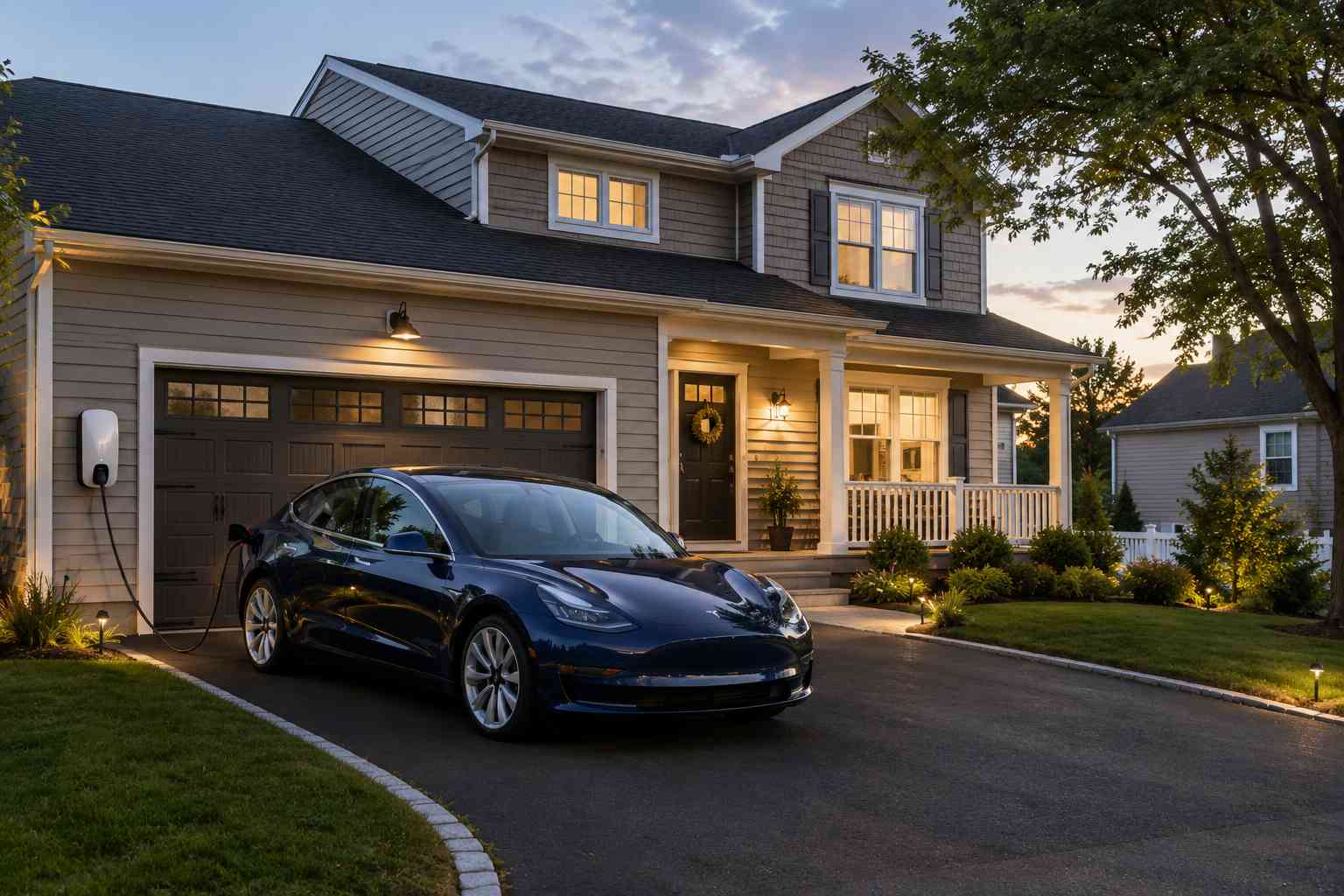
Nobody mentions the electricity bill until you’ve already signed the lease on the car. Insurance? Sure, they’ll walk you through it. Registration? Also covered. But the real monthly EV charging cost? That part gets skipped in almost every sales pitch. So here’s the version with actual numbers, install prices, what you’ll pay each month, and the New York rate programs most guides leave out entirely.
TL;DR
- Home charging beats gas per mile in New York, even with electricity rates that sit above the national average.
- Drive 1,000 miles a month and your EV charging cost will likely land between $35 and $70.
- Level 1 needs no installation, but you’re only getting 3 to 5 miles of range per hour. Level 2 needs a dedicated circuit and delivers 20 to 40 miles per hour.
- A home ev charger installation runs anywhere from a few hundred dollars to a few thousand. The deciding factor is almost always your electrical panel.
- Con Edison’s SmartCharge New York program pays you for charging off-peak while you stay on the standard rate.
- Con Edison’s Time-of-Use rate drops off-peak pricing to around 5 cents per kWh but you can’t enroll in TOU and SmartCharge at the same time.
- National Grid, PSEG, PECO, and PPL Electric each have their own EV programs worth a look.
- Cold weather can push your charging cost up 10 to 20% for the same mileage.
How Much Does It Cost to Charge an Electric Car?
Three things decide the number: your electricity rate, how efficient your car is, and how many miles you actually drive. A driver putting 1,000 miles on the odometer each month typically lands somewhere between $35 and $70. Compare that to what the same driving costs at the pump, and it’s not close.
What Does It Cost to Install an EV Charger at Home?
Before you get to the monthly number, there’s the equipment to think about.
Level 1 charging uses a standard 120-volt outlet, no installation, no electrician, no wait. Plug it in and walk away. The tradeoff is speed. You’re adding 3 to 5 miles of range per hour, which is fine if you barely drive, and painfully slow if you’re trying to replace a real commute overnight.
Level 2 is where most EV owners end up staying. It needs a dedicated 240-volt circuit, similar to what your dryer runs on, and it adds 20 to 40 miles of range per hour depending on the unit. The cost to install an EV charger at home typically falls somewhere between a few hundred dollars and a few thousand, and your electrical panel is usually what decides which end of that range you land on. Panel already has capacity? You’re in good shape. Does the panel need an upgrade first? The price climbs fast.
A few things that move that number around:
- How far the panel sits from where the car actually parks
- Whether the panel already has room, or needs an upgrade
- Local permit and inspection fees, which vary by town
- The charger itself a bare-bones unit versus one with app scheduling built in
Get two or three quotes before committing to anything. The panel question alone is usually what separates a $600 job from a $3,000 one, and some electricians won’t flag it until they’re already standing in your garage, a frustrating way to watch your quote double.
What Is Level 2 Charging, and Why It’s the One Most People Need
Level 2 charging isn’t a luxury upgrade so much as the thing that makes owning an EV actually workable day to day. Drive 30 miles a day, and a Level 1 setup might spend the whole night just trying to catch up. A Level 2 charger clears that same gap in under two hours.
Here’s the part people miss: charger speed doesn’t touch your per-kWh price. That’s entirely about your electricity rate. What a faster charger buys you is flexibility: the ability to wait for cheap overnight hours instead of plugging in the second you pull into the driveway.
Doing the Math on EV Charging Cost
Most EVs use somewhere between 25 and 35 kWh per 100 miles, depending on the model. Multiply that by your monthly mileage, then by your rate, and you’ve got your answer.
Drive 1,000 miles a month in a car that uses roughly 30 kWh per 100 miles, and you’re looking at 300 kWh total. At a blended New York rate somewhere in the 20-to-27-cent range, that puts your ev charging cost around $60 to $81 before any time-of-use savings. If you want to see what actually moves electricity prices in New York, that rate isn’t fixed it shifts with the season, your utility, and market supply costs.
Set that next to a comparable gas car getting 30 mpg at current New York prices, and the EV wins on cost per mile comfortably, before New York’s own incentive programs even enter the picture.
A Real-World Example: Charging in Westchester
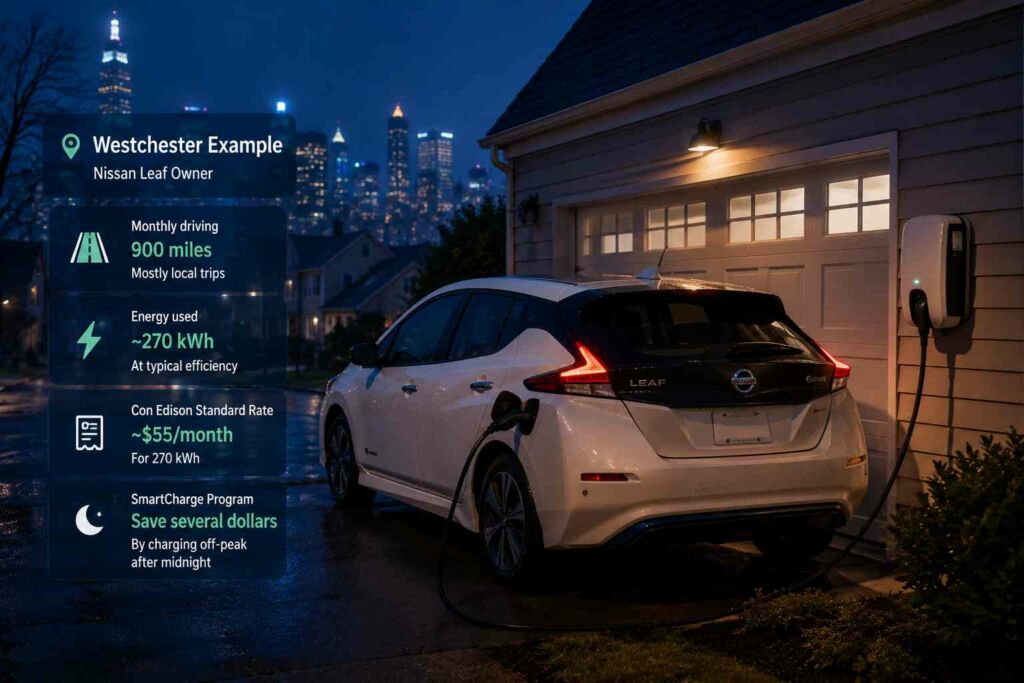
Take a Nissan Leaf owner in Westchester driving about 900 miles a month, mostly local trips with the occasional run into the city. That works out to roughly 270 kWh at the car’s typical efficiency. On Con Edison’s standard rate, that lands close to $55 a month. Enroll in SmartCharge and shift most of that charging past midnight, and the incentive payments alone can shave several dollars off sometimes more, depending on how consistently the charging happens off-peak. Not life-changing on its own, but it adds up over a year, and enrolling costs nothing.
New York’s EV Rate Programs (And Why They Matter)
This is the part most national cost calculators skip entirely and it’s where the real savings live if you’re in Con Edison territory or served by a similar utility.
Con Edison’s SmartCharge New York program pays you for charging off-peak while you stay on the standard residential rate. Skip the switch to time-of-use pricing, and you keep that eligibility worth knowing before you assume the fancier rate plan automatically wins.
Con Edison’s actual Time-of-Use (TOU) rate works differently. Off-peak hours run midnight to 8 a.m., and the published off-peak delivery rate sits around 5 cents per kWh a fraction of daytime pricing, and even less compared to Summer Super-Peak hours (2 to 6 p.m. on weekdays, June through September). If your car sits plugged in overnight anyway, TOU can beat a flat rate by a real margin. The catch: enrolling locks your whole home into the TOU rate for a year, unless you install a second EV-only meter. For more on how these numbers get set in the first place, see our guide to how NY utility rates are set.
And here’s where people trip up choosing TOU means giving up SmartCharge eligibility. You genuinely can’t have both. Run the numbers on each based on your actual charging habits before deciding.
Outside Con Edison’s territory, National Grid, PSEG, PECO, and PPL Electric each run their own version of EV-specific pricing. Check directly with whichever utility serves your address don’t assume Con Edison’s numbers apply everywhere.
The Easiest Savings Almost Nobody Bothers With
Even without a dedicated EV rate, shifting your charging into off-peak hours helps, assuming your utility offers time-of-use pricing at all. Most smart chargers can be scheduled to kick on automatically at 1 or 2 a.m. and just handle it. Set it once, forget about it, and the savings show up on their own, month after month. Pair that habit with a few other strategies to reduce your home electric bill, and the EV addition to your bill shrinks even further. You can also check the Department of Energy’s summary of Con Edison’s EV incentives for the full, current list of programs.
Curious how peak and off-peak pricing actually works beyond EVs specifically? Our breakdown of time-of-use electricity rates covers which New York and Pennsylvania utilities offer TOU and how the windows compare.
Quick Cost Comparison
| Charging Method | Speed | Typical Monthly Cost (1,000 mi) |
| Level 1 (standard outlet) | 3–5 mi/hr | Similar total, much slower |
| Level 2, standard rate | 20–40 mi/hr | ~$60–$81 |
| Level 2, off-peak TOU rate | 20–40 mi/hr | Often 20–40% lower |
| Public fast charging | Fastest | Usually the priciest per kWh |
Public chargers earn their keep on road trips, but you’re paying for speed and convenience there, not a competitive rate. Home charging wins on cost almost every time.
Will Charging an EV Spike My Electric Bill?
Noticeably, yes but not unpredictably. Adding 300 kWh a month is a real jump, often the biggest single addition to a household’s usage in years. The upside is consistency: once you know your car’s efficiency and your average mileage, that added cost barely wiggles from month to month, unlike heating or cooling bills that swing with the weather.
How Long Does a Full Charge Take?
Depends on the charger and how empty the battery is. Level 1 can take 24 to 40 hours from near-empty, which is why almost nobody uses it to charge from zero it’s a top-off tool, not a real charging strategy. Level 2 gets you from empty to full in roughly 4 to 10 hours, which fits into a normal overnight window for most drivers.
Worth Checking Your Supply Rate Too
Adding a home EV charger means adding real, permanent load to your electric bill. That’s a good excuse to check whether your current electricity supply rate is actually competitive, separate from whatever your utility charges for delivery. Comparing plans through a licensed supplier is one part of this whole equation you can actually control.
Compare electricity plans now →
Does Weather Affect EV Charging Cost?
A bit, yes. Cold weather makes EVs less efficient batteries simply don’t perform as well below freezing so winter charging sessions can run 10 to 20% higher for the same mileage. Nothing dramatic, but worth factoring in if you’re comparing a January bill to a June one and wondering why the numbers don’t line up.
The Bottom Line on EV Charging Cost in New York
Home charging beats gas on cost almost every time in New York, even before any special programs enter the picture. What you pay for installation depends on your home’s wiring. What you pay each month depends on your mileage and your rate. SmartCharge and Time-of-Use each bring that number down in their own way just not at the same time so the right choice comes down to your actual charging habits, not the national average.
FAQs
How much does it cost to charge an EV at home in New York each month?
The cost depends on how far you drive, your EV’s efficiency, and the electricity rate you pay. A simple way to estimate the monthly cost is:
Monthly charging cost = miles driven ÷ EV efficiency × electricity rate
For example, if an EV uses 30 kWh to travel 100 miles and you drive 1,000 miles, the vehicle would use about 300 kWh of electricity. At an electricity rate of $0.20 per kWh, that would be about $60 before accounting for charging losses.
Your actual cost can be higher or lower depending on your vehicle, charging efficiency, and electricity plan.
Is it cheaper to charge at home or at a public station?
Home charging is often less expensive than public charging, but the difference depends on the electricity rates and charging network you use.
Home charging generally means paying your residential electricity rate, while public charging may include:
- A higher per-kWh rate
- Session or connection fees
- Time-based charges
- Different pricing for faster chargers
Home charging can become particularly attractive if you have access to lower-cost electricity during certain hours. However, public charging may still be useful for road trips or when home charging isn’t available.
How much does it cost to install a Level 2 charger at home?
A Level 2 charger can cost anywhere from hundreds to several thousand dollars once equipment and installation are considered. The final price depends heavily on the electrical work required at your property.
Costs can be affected by:
- Charger hardware
- Distance between the electrical panel and parking location
- Required wiring and circuit installation
- Electrical panel capacity
- Permits and inspection requirements
- Whether a panel upgrade is necessary
Getting an electrician to assess the installation location before purchasing a charger can help you understand the total project cost.
Can I use SmartCharge New York and a Time-of-Use rate together?
Eligibility depends on the specific program rules and utility offering, so you should check the current terms before enrolling in either program.
When comparing the two options, consider:
- Your typical EV charging schedule
- Your electricity rate during charging hours
- Available incentives
- Program eligibility requirements
- Any enrollment conditions
The cheapest option isn’t necessarily the one with the largest advertised incentive. Your actual charging behavior determines how much value you can receive from a time-based rate or EV incentive program.
Does charging an EV significantly raise my electric bill?
It can increase your electricity usage noticeably because charging an EV adds another substantial electrical load to your home.
For example, an EV that uses about 30 kWh per 100 miles and is driven 1,000 miles per month would require roughly 300 kWh for driving, before accounting for charging losses.
Your additional cost depends on your electricity rate:
EV charging cost = charging kWh × electricity rate
The increase may be easier to manage if you charge during lower-cost periods available under your electricity plan.
How long does it take to fully charge an EV at home?
Charging time depends on the vehicle’s battery size, the charger’s power output, and the vehicle’s maximum charging rate.
Typical home options include:
- Level 1: Uses a standard household outlet and can take roughly a day or longer for a substantial recharge.
- Level 2: Uses higher-voltage equipment and can often recharge an EV overnight, with many vehicles taking several hours.
- DC fast charging: Much faster, but it is generally used at public charging stations rather than typical home installations.
You don’t always need to charge from empty to full. For many drivers, overnight Level 2 charging provides enough range for the next day’s driving.