

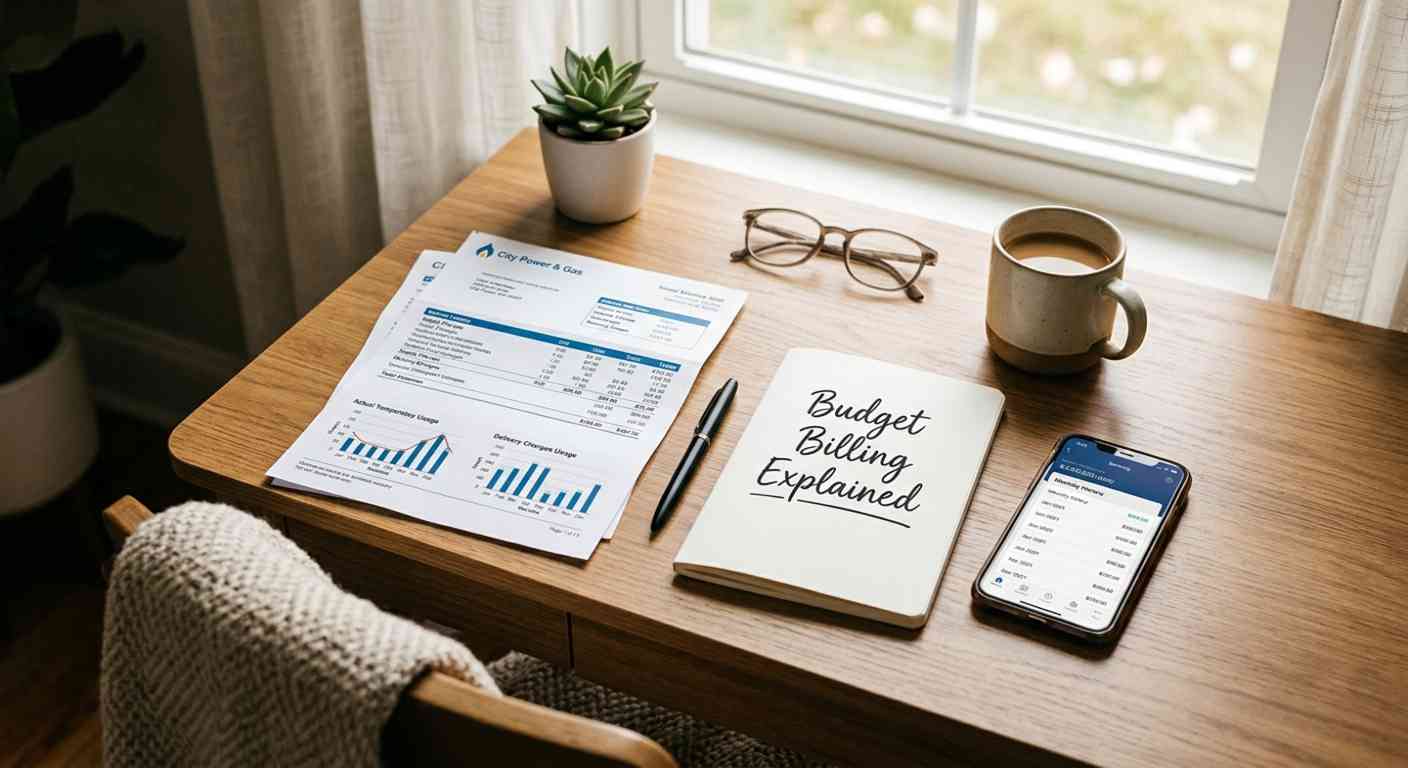
Open your utility bill in January and it’s $340. Open it again in July and it’s $95. Nothing about your habits changed that muchyou didn’t suddenly triple your AC use or stop running the heat. That’s just what a typical utility bill looks like when it tracks actual usage month to month, and it’s exactly the kind of swing that makes people go looking for budget billing in the first place.
So what is budget billing, really? It’s a payment option offered by most utility companies where instead of paying whatever your actual usage costs that month, you pay a fixed, averaged amount every month, based on your household’s estimated annual usage. Con Edison, National Grid, PECO, and PPL Electric all offer some version of this, and the mechanics are nearly identical across providers, only the enrollment process and true-up schedule differ.
TL;DR
- Budget billing averages your last 12 months of usage into one flat monthly payment, instead of a bill that swings with the seasons.
- It’s the same thing as levelized billing, different name, same math.
- It doesn’t lower your total annual cost. You still pay for every unit of gas and electric you use; you’re just paying it on a smoother schedule.
- The real win is predictability, not savings. A flat $180 every month beats a $340 January and a $95 June if surprises are what stress you out.
- Once a year, there’s a true-up: your utility checks what you paid against what you actually used, then bills you the gap or refunds the overage.
- Con Edison, National Grid, PECO, and PPL Electric all run their own version of this enrollment happens directly through your utility, not through your energy supplier.
- If your real goal is a lower rate, not just a steadier bill, that’s a separate fix it comes down to your supply plan, which is where switching providers actually moves the number.
- Pairing the two budget billing for smooth payments, a competitive fixed-rate supply plan for the actual cost is usually the combination that helps the most.
What Is a Utility Bill, Actually?
Before budget billing makes sense, it helps to know what’s inside a utility bill in the first place. If you’ve ever wondered what includes a utility bill or what is considered a utility bill, the short answer is: it depends on where you live and who supplies your energy. In deregulated states like New York and Pennsylvania, your bill can include two separate charges, the delivery charge from your local utility (the wires and infrastructure) and the supply charge for the actual energy you use, which you can often choose to get from a different provider than your utility.
That distinction matters because budget billing usually only smooths out the total dollar amount you owe to the underlying usage or rate. Your gas and electric usage still fluctuates with the seasons. Budget billing just changes how that fluctuation hits your wallet.
How Budget Billing Works?
Here’s the general process, and it’s roughly the same whether you’re on Con Edison budget billing, a National Grid budget billing program, PECO budget billing, or budget billing through PPL Electric:
Your utility looks at your last 12 months of usage (or estimates it, if you’re new to the address) and calculates an average monthly cost. That average becomes your fixed payment for the next 11 months. In month 12, there’s a “true-up”your utility compares what you actually paid against what you actually used, and settles the difference. If you underpaid over the year, you owe the balance. If you overpaid, you get a credit or refund.
This is sometimes called levelized billing, and it’s the same idea by a different name. Some providers use “budget billing” and “levelized billing” interchangeably in their own materials, so don’t assume they’re two different programs if you see both terms while comparing options.
Does Budget Billing Save You Money?
This is the question most people actually care about, and the honest answer is: not directly. Budget billing doesn’t lower your rate, reduce your usage, or shrink your annual total. If you use $2,400 worth of gas and electric in a year, you’re still paying $2,400 for it, budget billing just spreads that number into 12 even chunks instead of a big winter spike and a small summer dip.
Where it helps is predictability, not savings. A fixed number is easier to plan around than a bill that jumps by 150% between seasons and that kind of unpredictable swing is a real complaint people have across ESCOs and utilities alike, not something isolated to one company. If you’re the type of household living paycheck to paycheck, or you’ve been burned by a surprise $400 bill in January, having a flat, known number every month can matter more than shaving a few dollars off your annual total.
There’s one indirect way budget billing can help your finances, though: it makes overspending easier to notice. When your bill is the same every month, a sudden true-up bill at the end of the year becomes a visible signal that your usage crept up which can push you toward efficiency changes (better insulation, smarter thermostat use) that do save real money.
Who Budget Billing Actually Makes Sense For?

Budget billing tends to help renters and homeowners on tight, fixed monthly budgets who’d rather pay $180 every month than $95 in June and $340 in January. It also tends to appeal to households that have been shopping around for utility bill assistance or looking into payment plans for utility bills, since a flat monthly rate is one less variable to manage.
It makes less sense if you’re disciplined about saving and would rather bank money during low-usage months to cover the high ones yourself, interest-free, on your own terms. And it’s worth remembering that if your usage habits change significantly mid-year, say you start working from home, or you finish a home addition, your budget billing amount may need to be recalculated, sometimes mid-cycle.
Where to Sign Up
If you want to explore budget billing, the enrollment usually happens directly with whichever company handles your bill pay. Con Edison bill pay customers can enroll through Con Edison directly. National Grid bill pay customers do the same through National Grid. PECO and PPL Electric utilities customers can check with those providers directly too, since enrollment windows and eligibility can vary by account history.
If your goal is really about lowering what you pay overall not just smoothing it out that’s a separate conversation from budget billing, and it comes down to your actual electricity and gas supply rate. That’s the piece City Power & Gas focuses on: competitive, transparent supply pricing with renewable energy options, backed by a 90-day satisfaction guarantee, so you’re not locked into a rate you regret. Pairing your utility’s budget billing option with a straightforward supply plan is often the combination that actually moves the needle one smooths your payments, the other lowers what you’re paying for in the first place.
A Quick Word on Trust
A lot of the hesitation people have around switching anything related to their utility bill supply, billing structure, or provider comes from past bad experiences. Complaints about confusing pricing, unexpected rate hikes, and long hold times are well documented across the ESCO industry, and state regulators in New York and Pennsylvania actively track these complaints for a reason. That history is worth keeping in mind, and it’s exactly why reading the actual terms of any billing program or rate plan before enrolling is worth the ten minutes it takes.
The Bottom Line
Budget billing won’t make your energy cheaper. What it does is turn an unpredictable, seasonal expense into a flat monthly number you can plan around, with a true-up at the end of the year to settle any gap. For a lot of households, that trade-off is worth it. If your bigger concern is the rate itself, not just when you pay it that’s where looking at your actual supply plan comes in.
Curious what a transparent, renewable-friendly supply plan looks like without the guesswork? See if City Power & Gas is available in your area and enroll in a few minutes.
FAQs
1. How is the Budget Billing amount calculated?
Budget Billing is generally designed to make your monthly payments more predictable rather than reduce the total amount of energy you use.
The utility may calculate your payment using:
- Your past electricity or natural gas usage
- Previous energy costs
- Current or expected rates
- Seasonal usage patterns
- An estimate if there is not enough billing history
The resulting amount is spread across regular monthly payments. The utility then compares what you paid with the actual cost of your energy use through periodic adjustments or a true-up.
2. I’ve lived at my current address for less than a year. Can I still enroll?
Usually, yes. Not having 12 months of billing history does not necessarily prevent you from enrolling in Budget Billing.
If there isn’t enough historical data, the utility may estimate your expected usage using information such as:
- Previous usage at the property
- Type of heating system
- Property characteristics
- Seasonal energy consumption
- Available billing history
Your budget amount may be adjusted later as the utility gets more information about your actual usage.
3. When does Budget Billing take effect?
Budget Billing generally takes effect after you enroll and the utility processes the request. The exact timing depends on the utility and where you live.
Depending on the program, your new budget amount may begin:
- On your next billing cycle
- After the current bill is issued
- During a specific enrollment period
Check your utility’s Budget Billing terms to confirm when the new payment amount will appear on your bill.
4. Does the Budget Billing amount ever increase or decrease?
Yes. Your Budget Billing amount can change when the utility reviews your account and determines that your current payment no longer matches your expected energy costs.
The amount may change because of:
- Higher or lower energy usage
- Changes in electricity or gas rates
- Seasonal consumption patterns
- A growing account balance or credit
- Updated usage estimates
This means Budget Billing does not guarantee the same monthly payment forever. The utility can adjust the amount to better reflect your expected annual costs.
5. What happens if I pay more than my monthly Budget Billing amount?
Paying more than the required Budget Billing amount generally creates a credit or reduces any outstanding balance on your account.
However, an extra payment does not necessarily mean your future Budget Billing amount will automatically decrease. The utility will account for the difference when it reviews your account or performs its applicable settlement.
If you regularly pay more than required, check your bill to see whether the additional amount is being applied as an account credit.
6. What happens if I pay less than my monthly Budget Billing amount?
Paying less than the required amount can leave an unpaid balance on your account. Budget Billing does not eliminate the actual cost of the energy you use; it only changes how those costs are spread across your bills.
A growing balance may result in:
- A higher future Budget Billing amount
- A balance that must be paid at a later settlement
- Late-payment consequences if the required payment is not made
- Possible changes to your account status
If you are having difficulty making the required payment, contact your utility before missing payments to ask about available payment assistance or payment arrangements.
7. What happens to my Budget Billing if I transfer my service to a new address?
Budget Billing generally does not transfer automatically from one property to another because the program is based on the expected energy costs associated with a particular service address.
When you move, your utility may:
- Settle the Budget Billing balance at your old address.
- Apply any credit or remaining balance according to its rules.
- Close or transfer the existing account.
- Calculate a new Budget Billing amount for the new property if you enroll again.
Contact your utility before moving so you understand how your existing balance will be handled and when service should end at the old address.
8. Can I enroll in other billing options if I’m on Budget Billing?
It depends on the utility and the specific billing program. Some billing options may require you to leave Budget Billing before enrolling in another payment structure.
Before making a change, ask your utility:
- Whether the programs can be combined
- Whether your current account balance must be settled
- When the new billing option takes effect
- Whether leaving Budget Billing changes your monthly payment
Different billing programs can have different eligibility and enrollment requirements.
9. May I enroll in payment plans if I’m on Budget Billing?
Possibly. Budget Billing and a payment arrangement serve different purposes, so some utilities may allow customers to use additional payment options when they have difficulty paying their balance.
For example, a utility may offer a separate payment arrangement for customers who have an outstanding balance.
If you’re considering one, ask about:
- Eligibility requirements
- Required down payments
- Payment schedule
- Interest or fees, if applicable
- How the arrangement affects your Budget Billing account
Your utility can tell you which options are available for your specific account.
10. What happens if I decide to leave the Budget Billing program?
You can generally request to leave Budget Billing, although the exact process and timing depend on your utility.
When you leave, the utility may reconcile your account by comparing:
Actual energy costs − payments already made = remaining balance or credit
If you have paid more than the actual cost, you may have a credit. If your actual energy costs exceed your payments, you may have a balance to pay.
After leaving the program, your future bills generally return to reflecting your actual monthly energy usage rather than a smoothed Budget Billing amount.


