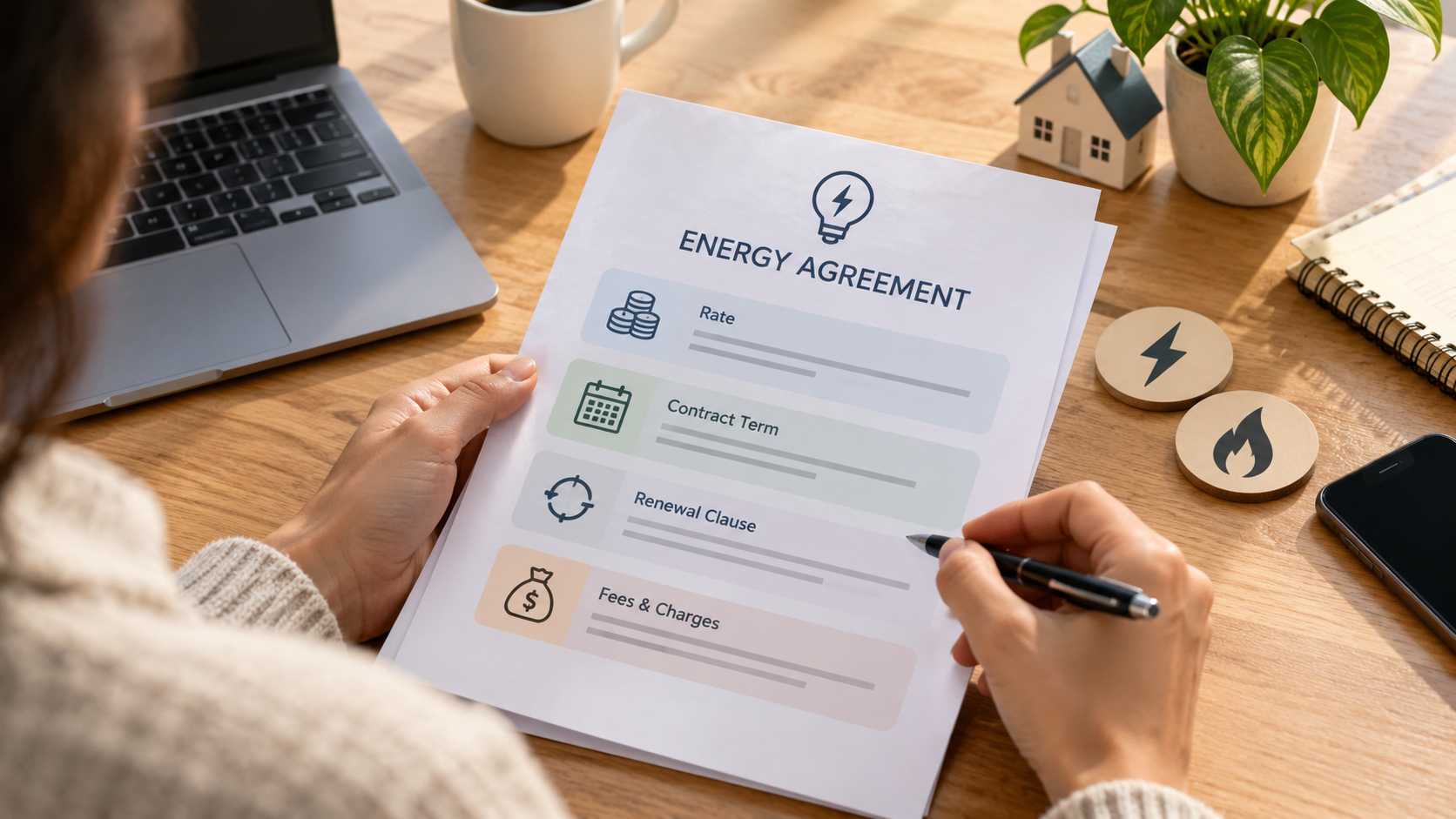
Most people never read their energy agreement. They skim the first page, see a rate that sounds fine, and sign. That’s how someone ends up locked into a two-year contract with a cancellation fee they didn’t know existed, or on a variable rate that climbs sharply in January. An energy agreement is really just a short contract: a rate, a term length, a renewal clause, and a few fees. Once you know what each section means, reading one takes about five minutes. Here’s what to look for before you sign anything with an electricity or natural gas supplier in New York.
TL;DR
- A fixed rate stays the same for the contract term; variable energy rates move with the market.
- Mark your contract expiration date. Suppliers must give notice before renewal.
- Check for an early termination fee (ETF) and read the exact dollar amount or formula.
- Ask about usage bandwidth clauses if your household’s energy use is likely to change.
- Watch for red flags: vague renewal terms, missing ETF numbers, or pressure to sign same-day.
- Compare any offer to your current utility rate before signing.
What Your Energy Agreement’s Rate Really Means: Fixed Rate vs. Variable Energy Rates
The rate section sits near the top of the agreement, and it’s the first thing to understand. A fixed rate locks in the same price per kilowatt-hour or therm for the length of your contract. Your bill still moves with how much you use, but the rate itself won’t change even if wholesale energy prices spike during a cold snap. A variable rate moves with the market instead. It can drop in a mild month and climb in a high-demand one, and most variable plans don’t carry a cancellation fee, since there’s nothing fixed to lock you out of.
Weighing fixed vs. variable costs comes down to how much price swings bother you. If you want a predictable bill and plan to stay put through the contract term, a fixed rate is usually the safer pick. If you’re comfortable with some monthly movement and want the freedom to leave anytime, variable energy rates might suit you better. CPG offers both, and you can see how CPG structures its fixed and variable plans before deciding which fits your household.
Check the Contract Expiration Date First.
Every energy agreement has a contract expiration date, and it matters more than most shoppers realize. Fixed-rate agreements run anywhere from a few months to a few years. When the term ends, suppliers typically roll customers onto a renewal rate instead of just stopping service, and that renewal rate can run higher than what was originally signed.
New York regulators require suppliers to notify residential customers before a contract renews, spelling out the new terms and giving the customer a chance to reject them. The New York Department of Public Service outlines these renewal rules in its supplier-shopping guide, along with what a supplier can and can’t do as a contract nears its expiration date. Write that date down somewhere you’ll actually see it. It’s the easiest way to avoid getting rolled onto a rate you never agreed to.
The Early Termination Fee (ETF) Nobody Reads.
Fixed-rate agreements often include an early termination fee, usually shortened to ETF, charged if you cancel before the contract runs out. In New York, these fees are capped by law and must be spelled out in the customer disclosure statement that comes with every agreement, generally somewhere between $50 and $200 depending on how much time is left on the contract. Variable-rate plans almost never carry one.
Before signing, find the ETF line and read it twice. If the document doesn’t list a dollar amount or a clear way to calculate one, ask the supplier directly rather than assuming it matches what you were told over the phone. CPG’s rate FAQ breaks down how fixed and variable terms compare, which is a useful gut check if a number in your paperwork looks off.
Usage Bandwidth Clauses: The Fine Print Most Shoppers Skip!
Some agreements include a usage bandwidth clause, a provision that lets the supplier adjust or cancel pricing if your actual usage falls far outside the estimate on file. It’s meant to protect suppliers from mismatched risk, not to penalize ordinary shifts in usage, but it can catch someone off guard during a move, a renovation, or a change in household size.
If your usage is likely to change soon, say you’re downsizing or taking on a roommate, it’s worth asking whether your agreement has a usage bandwidth clause and what triggers it. This comes up often for renters specifically, which we covered in our guide to switching energy suppliers as a renter.
Red Flags to Watch For in Any Energy Agreement!
A handful of red flag warning signs should make you slow down before signing anything:
- No early termination fee listed, or a number that changes between the phone call and the paperwork.
- A renewal clause that doesn’t state how much notice you’ll get before the contract rolls over.
- Vague language around what counts as a usage bandwidth violation.
- A guaranteed savings claim with no written terms attached to it.
- Pressure to sign the same day, especially from a door-to-door representative.
None of these automatically mean a supplier is acting in bad faith. Contract language varies, and some of it is just standard industry wording. But any one of these red flags is reason enough to ask questions before you commit. The New York Public Service Commission’s consumer protections page lists exactly what every supplier is legally required to disclose, under the Home Energy Fair Practices Act.
A Five-Minute Way to Read Any Energy Agreement.
Once you know what to look for, reading an energy agreement takes less time than you’d think. Run through these in order:
- Confirm the rate type, fixed rate or variable, and the exact price per kWh or therm.
- Find the contract expiration date and how much notice you’ll get before renewal.
- Locate the ETF and the dollar amount or formula behind it.
- Check for a usage bandwidth clause and what triggers it.
- Compare the rate to your utility’s current supply rate, so you know what you’re actually saving.
That covers the whole document, stripped down to the parts that actually change your bill. Everything else is mostly standard language required by state regulators.
If you’re shopping for a new plan in New York, CPG’s team is glad to walk through an agreement with you line by line before you sign anything, and every plan comes with a 90-day no-risk guarantee. Shop current fixed and variable plans to see today’s rates and contract terms.
FAQs
1. What’s the difference between a fixed rate and variable energy rates?
A fixed rate stays the same for the length of your contract, so your price per kWh or therm never changes. Variable energy rates move with the market instead, going up or down monthly. Fixed rates offer predictability, variable rates offer flexibility and usually no cancellation fee.
2. How do I find my contract expiration date on my agreement?
Check the customer disclosure statement that came with your agreement. It lists the contract term length and the start date, which together tell you the exact contract expiration date. If you can’t locate it, call your supplier and ask them to confirm it in writing.
3. What happens if I don’t cancel before my contract expires?
Most suppliers roll you onto a renewal rate instead of ending service. That rate can be higher than what you originally signed for. New York rules require notice before this happens, so review the renewal terms in that notice and decide whether to stay, switch, or return to utility service.
4. What is an early termination fee (ETF) and how much does it usually cost?
An ETF is a charge for cancelling a fixed rate agreement before the contract term ends. In New York, it’s capped by law and must be listed in your disclosure statement, typically between $50 and $200 depending on how much time remains. Variable rate plans usually don’t carry one.
5. Do variable rate plans have an early termination fee?
Usually not. Since a variable rate changes with the market instead of being locked in, there’s nothing fixed for a supplier to protect with a cancellation charge. Most variable rate agreements let you cancel anytime without penalty, but always confirm this in your own customer disclosure statement rather than assuming.
6. What is a usage bandwidth clause and why does it matter?
It’s a provision letting a supplier adjust or cancel pricing if your actual usage falls far outside the estimate on file. It matters because moving, renovating, or a change in household size can trigger it unexpectedly, so it’s worth checking for before your usage is likely to shift.
7. How do I know if my agreement has a usage bandwidth clause?
Look through the terms and conditions section of your written agreement, not just the summary page. It’s often listed under pricing or usage provisions. If you can’t find clear language either way, ask your supplier directly and request the answer in writing for your records.
8. What counts as a red flag in an energy agreement?
A few examples of red flags are listed below :
- No ETF listed, or a number that changes between the phone call and paperwork.
- A renewal clause with no stated notice period.
- Vague wording around usage bandwidth triggers.
- Guaranteed savings claims with no written terms attached.
- Pressure to sign the same day.
9. Can a supplier change my rate without telling me?
No, not on a fixed rate plan during its term. Variable rates can change monthly since that’s how the plan is structured. For any other change to price or contract terms, New York rules require the supplier to send advance notice and get your consent before applying it.
10. How much notice must I get before my contract renews?
New York requires suppliers to notify residential customers before a fixed rate contract renews, spelling out the new terms and your options as a customer. Check the renewal section of your agreement for the exact number of days, since it’s listed there along with how to reject the new terms.
11. What’s included in a customer disclosure statement?
It summarizes the key terms of your agreement in one place:
- The rate type and price
- Contract length and expiration date
- The ETF amount or formula
- Renewal notice requirements
- Any savings guarantees
It’s shorter than the full agreement, so start there before reading the rest.
12. Is CPG’s rate fixed or variable?
CPG offers both. Fixed rate plans run from 3 to 36 months and lock in your price for that term, while variable rate plans move with market pricing month to month. Which one fits depends on whether you value a predictable bill or pricing flexibility more.
13. What should I do if a representative pressures me to sign the same day?
Slow down. A legitimate offer will still be available tomorrow, and you’re entitled to take the agreement home and read it first. If someone insists you sign on the spot or refuses to leave a written copy, treat that as a red flag and ask for time.
14. How do I compare my energy agreement to my utility’s rate?
Check your utility bill for its current supply rate per kWh or therm, usually listed separately from delivery charges. Compare that number to your agreement’s rate. A fixed rate that’s higher than the utility rate can still make sense if you value price stability over time.
15. Who do I contact if I think my agreement includes an illegal fee?
Start with your supplier directly and ask them to explain the fee in writing. If that doesn’t resolve it, the New York Department of Public Service handles complaints about ESCO contracts and can review whether the fee complies with state rules and consumer protections.