

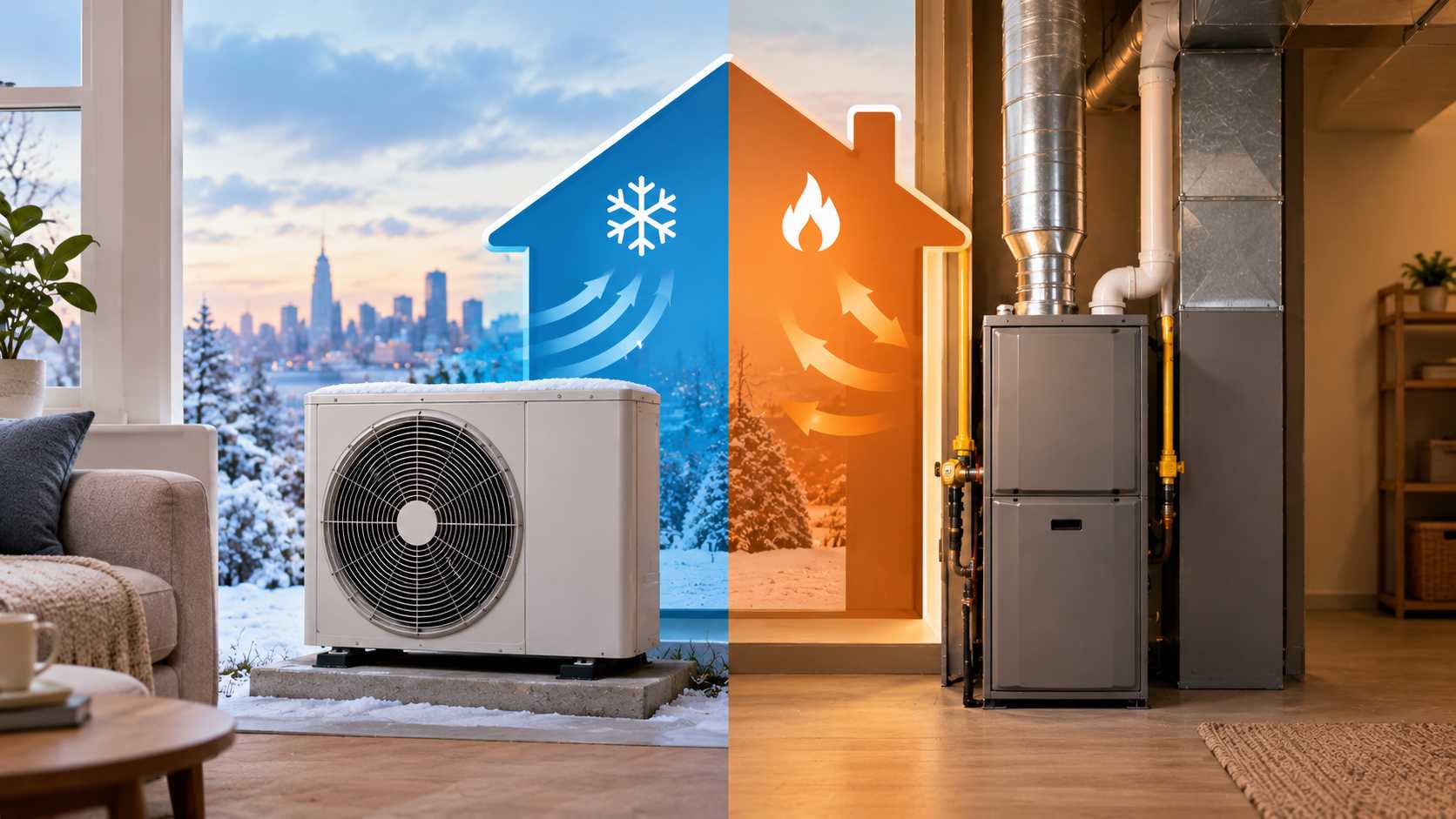
Every comparison between heat pump and gas furnace online always says the thing: heat pump wins always with no exceptions. That is not exactly true in New York. The reason is that most of these comparisons leave out what you are actually paying per kilowatt-hour versus per therm of gas right now in your state.
Here is the real calculation, built from New York electricity and gas prices, actual installation cost ranges and the NYSERDA rebate program as it exists today, not a generic national average that doesn’t apply to your utility bill.
TL;DR
- Heat pump installation cost runs $8,000 to $20,000. For a ducted cold-climate system, versus $3,800 to $10,000 for a gas furnace in New York.
- At New York’s electricity prices (27-30 cents/kWh) versus gas prices ($16-21/Mcf) a gas furnace is often cheaper to run per unit of heat delivered, especially in cold weather when heat pump efficiency drops.
- Heat pumps tend to save money when replacing oil or propane heat, not necessarily when replacing existing gas heat.
- NYSERDA’s Clean Heat program offers installation rebates that vary by utility and income. They affect upfront cost, not your monthly operating cost.
- Heat pump maintenance and repair costs run differently than furnace costs with compressor failure being the expensive single risk over the system’s life.
- The right choice depends on your fuel source, ductwork and whether you value the lowest monthly bill or lower emissions more.
How a Heat Pump and a Gas Furnace Actually Work?
A gas furnace burns gas to create heat directly then pushes it through your ducts. Efficiency is measured in AFUE, Annual Fuel Utilization Efficiency and modern condensing furnaces have 95% AFUE meaning 95% of the fuel’s energy becomes usable heat.
A heat pump works differently. By creating heat it moves heat pulling warmth from outside air (even cold air, to a point) and concentrating it indoors through a refrigerant cycle. Run the cycle in reverse. The same unit cools your home in summer which is why a heat pump system also serves as your air conditioner. This efficiency is measured as COP, Coefficient of Performance, the ratio of heat delivered to electricity consumed. A COP of 3 means you get three units of heat for every unit of electricity you use which sounds like it should make electricity cheap by comparison. Whether that holds up depends entirely on what electricity costs where you live which is where New York is different from the national story.
Heat Pump Installation Cost vs Gas Furnace Installation Cost
Gas furnace installation in New York typically costs between $3,800 to $10,000 installed with many standard replacements landing between $4,000 and $6,500. The exact number depends on furnace efficiency whether your existing gas line and venting are ductwork condition.
Heat pump installation cost is higher upfront for a ducted whole-home system. A cold-climate air source heat pump, the type built to maintain heating capacity in temperatures typically installed for $8,000 to $20,000 or more depending on home size and whether your ductwork needs modification. A ductless mini-split system, which skips ductwork entirely and heats or cools room by room runs lower per zone $3,500 to $8,500 per indoor unit before installation labor.
The gap between these two numbers is the real cost most comparisons avoid. A heat pump is not a purchase than a furnace. The case for it rests on what happens after installation not before.
The Real Operating Cost: What NY’s Electricity and Gas Prices Mean for Your Bill?
This is the part that actually determines whether a heat pump saves you money. It is where New York’s specific pricing matters more than the national averages most articles use.
Through 2026 New York’s average residential electricity price has been 27 to 30 cents per kilowatt-hour consistently among the highest in the country. Average residential natural gas has been $16 to $21 per thousand cubic feet over the same period.
Converting both to an unit cost per million BTU of heat actually delivered to your home looks like this:
- Gas furnace at 95% AFUE: roughly $17 to $22 per million BTU delivered
- Heat pump at COP 3 (typical mild-weather performance): roughly $26 to $29 per million BTU delivered
- Heat pump at COP 2.5 (typical cold-weather performance): roughly $32 to $35 per million BTU delivered
- Heat pump at COP 3.5 (best-case mild shoulder-season performance): $23 to $25 per million BTU delivered
At New York’s current electricity prices a gas furnace is typically cheaper to run per unit of heat than a heat pump, especially during the coldest months when a heat pump’s COP drops. This is not true everywhere. In states with electricity and expensive gas the math flips.. In New York specifically the gap between electricity and gas prices is wide enough that heat pump operating savings are not guaranteed and for many homes they don’t happen at all during peak winter.
Where heat pumps do win in New York: if you are currently heating with oil or propane rather than natural gas since both cost much more than gas per BTU delivered. A heat pump versus furnace comparison looks very different depending on what you’re actually replacing.
NYSERDA Rebates: What They Actually Change About the Math?
New York’s NYS Clean Heat program administered through your utility (Con Edison, National Grid, NYSEG, RG&E, Central Hudson or Orange & Rockland) and NYSERDA offers incentives for qualifying heat pump installations. In 2025 the program issued over $208 million in incentives. Supported nearly 17,000 heat pump projects statewide with the vast majority being full air-source systems. Con Edison’s territory in particular saw over 99% of heat pump installations paired with decommissioning the old fossil fuel system.
Rebate amounts vary significantly by utility territory, household income and whether you are fully replacing fossil fuel heat or adding capacity so there is no single number that applies to every home. What’s worth knowing: these rebates apply to installation cost not operating cost. A rebate can meaningfully close the price gap between a heat pump and a furnace. It does not change the cents-per-kWh math on your bill. Check incentive levels for your specific utility territory at cleanheat.ny.gov before assuming a number from a national article applies to you since New York runs this program differently from most states.
Repair: The Cost Nobody Budgets For!
Heat pump maintenance and gas furnace maintenance are not the costs and skipping either one shortens the system’s life. A gas furnace needs inspection of the heat exchanger, burners and venting mainly for safety (carbon monoxide risk) rather than performance. Furnace repair costs tend to be moderate for issues like igniter or blower motor failure.
A heat pump runs year-round, heating in winter and cooling in summer which means more total operating hours and more wear on the compressor and outdoor coil. Heat pump maintenance typically includes coil cleaning and refrigerant level checks. Heat pump repair costs can run higher than furnace repairs when the compressor itself fails since that’s the expensive single component in the system. Over a 15-year equipment life, factor this into the comparison not the sticker price at installation.
Which One Actually Makes Sense for Your Home?
A situations where the math tends to favor each option:
Gas furnace often makes more sense when:
- You already have a gas line and functioning ductwork
- Your current system is gas and working fine just aging
- You are in an area with New York’s typical electricity-to-gas price gap and want the lowest predictable operating cost
Heat pump often makes more sense when:
- You are currently heating with oil or propane not gas
- You want central air conditioning and heating from one system
- You qualify for a substantial NYS Clean Heat rebate that closes the installation cost gap
- You are prioritizing lower emissions over the lowest possible monthly bill
Whichever heating system you choose it doesn’t change your options on the supply side of your bill. If you are staying on gas our Why CPG page covers how CPG’s fixed rate plans work.. If efficiency upgrades like better insulation are part of this decision too, our guide to home energy audits is a useful next step before committing to either system.
Sticking with gas heat for now? Shop CPG’s energy. Lock in a fixed rate while you weigh your options.
FAQs
If my home doesn’t have a gas line at all, does this comparison still apply to me?
Not directly. The blog’s cost math compares heat pump electricity against an existing natural gas connection. If you’re currently on oil, propane, or electric resistance heat instead, run the comparison against that fuel, not gas:
- Oil and propane cost substantially more per BTU than natural gas, which is exactly where heat pumps tend to win in NY
- Electric resistance heat (baseboard) is already more expensive than a heat pump at any COP above 1.0, so switching is close to a guaranteed win
Can I install a heat pump without removing my gas furnace?
Yes, this is called a dual-fuel or hybrid system, and it sidesteps a lot of the cold-weather math in the blog. The heat pump handles heating during mild weather when its COP is high, then the furnace automatically takes over below a set outdoor temperature when the heat pump’s efficiency drops. This avoids the worst-case cold-weather cost scenario entirely, at the expense of paying for two systems instead of one.
Does a heat pump still heat my home if the power goes out?
No, and neither does a gas furnace, since modern gas furnaces also rely on electricity to run their blower motor and ignition system. Neither system functions without power. If outage resilience matters to you specifically, that’s a backup generator question, not a heat pump vs furnace one.
My specific utility isn’t mentioned by name, how do I find my actual rebate amount?
The blog intentionally avoided a specific dollar figure because rebates vary by utility territory. To get your real number:
- Identify your utility (Con Edison, National Grid, NYSEG, RG&E, Central Hudson, or Orange & Rockland)
- Go to cleanheat.ny.gov and use their contractor or rebate lookup tool
- Confirm whether you qualify for income-based enhanced incentives, which can significantly change the number
If NY electricity prices come down in future years, would the math flip in favor of heat pumps?
It’s possible, since the comparison in the blog is a snapshot of current rates, not a permanent rule. If the gap between NY’s electricity and gas prices narrows, heat pump operating costs become more competitive. Worth knowing: NY’s electricity prices have trended upward for several years rather than down, so this isn’t something to bank on in the near term without checking current rates yourself.
Does switching to a heat pump affect my home’s resale value?
There’s no single verified figure for this, so treat any specific dollar claim with caution. What’s more established: having central air conditioning included (which a heat pump provides as a byproduct) and access to NYSERDA rebate documentation can both be selling points buyers notice during inspection, independent of the heating fuel debate itself.
I only want to replace my furnace with a heat pump for the AC benefit, not to save on heating. Does the cost math still matter?
Less so. If air conditioning is the primary driver, you’re comparing heat pump installation cost against buying a central AC unit separately rather than against a furnace, since you’d need AC either way. In that case, the heating-season operating cost comparison in the blog becomes a secondary factor, not the deciding one.


