
If you rent in New York, you’ve probably never thought about whether you can switch energy supplier. You pay whatever the bill says, and it never occurs to you that there’s a choice involved at all. But New York opened its energy market to competition decades ago, and depending on how your lease is set up, that choice might already belong to you.
The short : it comes down to whose name is on the utility account. Here’s what that actually means, and what to check before you assume you’re stuck.
TL;DR
- Whether you can switch energy supplier depends on one thing: whose name is on the utility account.
- Account in your name? The choice is entirely yours, your landlord can’t block it.
- Utilities bundled into rent? The account belongs to your landlord, not you.
- Con Edison and National Grid still deliver power and handle outages no matter which ESCO you pick.
- HEFPA protects ESCO customers too: fair billing, a complaint process, and a three-day cancellation window after signing.
- Landlords can only bill you for utilities you actually use, not shared hallway or common-area usage.
- Always confirm an ESCO’s licensing status and contract terms before signing anything.
The One Thing That Decides Everything
Before anything else, figure out who holds the account. If your name is on the electric bill, you’re the account holder, and account holders in New York have the legal right to switch energy supplier whenever they want. Your landlord doesn’t get a say in that decision. It’s your account, your choice.
If utilities are bundled into your rent instead, meaning the landlord pays the utility directly and folds the cost into what you owe monthly, the account isn’t in your name. In that setup, you don’t have the standing to switch energy supplier yourself, because legally, you’re not the customer of record. The landlord is.
There’s a third, less common setup worth knowing about too: submetering. Some larger apartment buildings have a third-party company that buys energy in bulk and resells it to individual units, billing tenants separately from the main utility. Renters rights in submetered buildings can get murky fast, since the rules governing submetering companies aren’t always identical to the rules governing traditional utilities like Con Edison or National Grid.
How to Actually Switch Energy Supplier in New York
If the account is in your name, the process is more straightforward than most tenants expect.
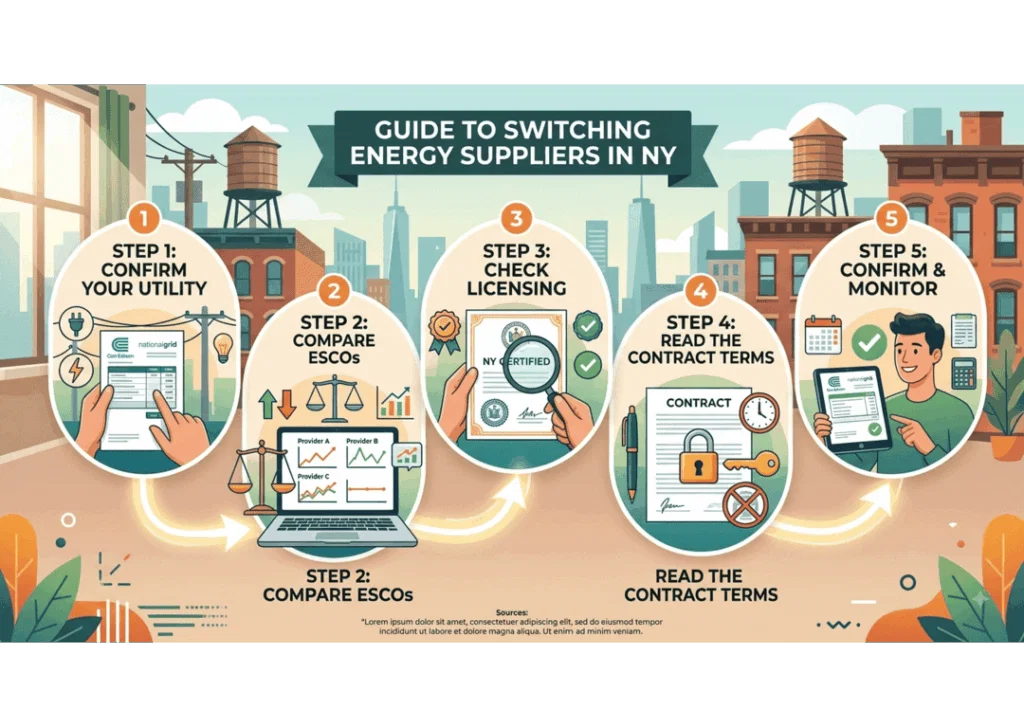
Step 1: Confirm your utility.
Your delivery utility, Con Edison, National Grid, or another regional provider, stays the same no matter who supplies your energy. Switching suppliers doesn’t touch the wires or the poles. Con Ed and National Grid still deliver the power and handle outages either way.
Step 2: Compare ESCOs.
An ESCO (Energy Service Company) is a licensed third-party supplier you can choose instead of sticking with your utility’s default rate. New York has dozens of them, and pricing structures vary a lot, some offer fixed rates, some offer variable rates that can spike without warning.
Step 3: Check licensing.
Every legitimate ESCO operating in New York has to be certified through the state. If a marketer is pushing a plan and can’t confirm their licensing status, that’s a red flag worth walking away from.
Step 4: Read the contract terms.
Look specifically for whether the rate is fixed or variable, how long the term runs, and whether there’s an early termination fee. This is the step most renters skip, and it’s the one that ends up costing them later.
Step 5: Confirm and monitor.
Once you switch energy supplier, your first bill after the transition is worth double-checking closely to make sure the new rate is actually reflected correctly.
What If Your Building Uses National Grid or Con Edison?
A lot of renters assume Con Edison and National Grid are the only options, since those are the names on the bill every month. That’s not quite right. Con Edison and National Grid are your delivery utilities, meaning they own the infrastructure and are responsible for keeping the power running. But the supply side, the part where the actual electricity gets priced and sold to you, is separate. That’s the piece an ESCO can step in and compete for.
So if you’re currently on Con Ed’s or National Grid’s standard supply rate, you’re not obligated to stay there. You can shop for a different rate through a certified ESCO while your delivery service stays exactly the same. This is the part of New York’s deregulated market that trips people up the most, they assume “switching” means changing who shows up to fix an outage, when really it just means changing who prices your electricity.
Utilities Included in Rent? Here’s What Changes
If your lease bundles utilities into rent, you’re not without options entirely, you just have a different set of questions to ask.
Start by asking your landlord directly whether the utility rate is fixed for your entire lease term, or whether it can be adjusted if their own costs go up. If your landlord’s account isn’t on a competitive ESCO rate, it might be worth mentioning that switching energy supplier on their end could lower costs for the building overall, which could translate to fewer rent hikes down the line. Landlords don’t always think to check.
It’s also worth understanding your renters rights around shared utility costs specifically. Under New York Real Property Law §235-a, landlords can only bill tenants for utilities that a tenant actually consumes. If your meter also covers a hallway, a shared laundry room, or another unit, your landlord is responsible for covering that portion, not you. If you suspect you’re being overcharged for shared usage, the NY Department of Public Service can investigate on request.
Renters Rights Under HEFPA
New York’s Home Energy Fair Practices Act, known as HEFPA, covers more than just utility customers. It was extended in 2002 to also protect customers of competitive suppliers, meaning if you switch energy supplier and move to an ESCO, you keep the same core protections: fair billing practices, a formal complaint process, and required notice before service can be shut off.
You also get a three-day window to cancel a new supplier agreement after signing, no penalty, no questions asked. If a marketer pressures you into signing something on the spot, that three-day window is your safety net.
If you ever feel like a supplier isn’t playing fair, or if a marketer is being pushy about switching power supply on your behalf without giving you time to think it over, the NY DPS Consumer Services line handles exactly these kinds of complaints.
Vetting an ESCO Before You Commit
Not every ESCO markets to renters honestly, and it’s worth doing a little homework before signing anything. A few things to check:
- Licensing status. Confirm the ESCO is certified to operate in New York before engaging with any offer.
- Rate structure. Fixed rates are more predictable. Variable rates can start low and climb fast, sometimes without much warning.
- Contract length and exit terms. Some ESCOs lock you in with early termination fees that outweigh whatever you’d save switching.
- Reviews and complaint history. A quick search of an ESCO’s name alongside “complaints” can tell you a lot before you commit.
Understanding how a licensed energy supplier differs from a scam operation is worth reading in full if you’ve never gone through the switching process before, since the difference between a fair ESCO and a predatory one often comes down to details buried in the fine print.
The Bottom Line
Whether you can switch energy supplier as a renter in New York comes down to one question: whose name is on the account. If it’s yours, the choice is entirely yours to make, and the process is far simpler than most tenants assume. If it’s your landlord’s, your leverage is more limited, but you still have real renters rights around shared utility costs and billing transparency that are worth understanding.
Before signing a new lease, it’s worth asking upfront how utilities are structured, since that single detail determines how much control you’ll actually have over your energy costs. And if you find out the account will be in your name, comparing your options is worth the ten minutes it takes. Our guide on common myths about switching is a good next read if you’re on the fence, and if you’re ready to actually compare rates, our guide to finding a licensed energy supplier walks through the process step by step. If you want the state’s own overview of your rights as a New York energy customer, the NY DPS energy competition guide covers it directly.
FAQs
Can my landlord stop me from switching energy suppliers?
It depends on who holds the utility account.
- If the account is in your name: You can generally choose an eligible energy supplier for the supply portion of your electricity service.
- If the account is in your landlord’s name: You generally cannot switch the supplier yourself because you are not the account holder.
- If utilities are included in your rent: Check your lease to see how electricity costs are handled.
Before switching, confirm whose name appears on the utility account and whether your lease contains any relevant provisions.
Will switching energy suppliers affect my service reliability or outages?
No. Switching your energy supplier does not change the physical delivery of electricity to your home.
Your local utility remains responsible for:
- Maintaining the power distribution system
- Delivering electricity to your address
- Responding to power outages
- Maintaining utility infrastructure
The ESCO you choose supplies the electricity that is delivered through the existing utility system. You therefore do not need new power lines or separate electrical equipment when you switch suppliers.
What if utilities are included in my rent?
If electricity is included in your rent and your landlord controls the utility account, you generally cannot choose an ESCO yourself.
Start by checking:
- Who is listed as the utility account holder
- Whether electricity is included in your monthly rent
- How your lease says utility costs are calculated
- Whether your landlord passes the actual electricity cost on to you
If you want to understand whether you could benefit from a different supplier, ask your landlord whether the account is eligible for supplier choice and what rate is currently being charged.
What if I move out before my ESCO contract ends?
Check your ESCO agreement before enrolling, especially if you expect to move soon. Some contracts may include an early termination fee, while others may have different rules for customers who move.
Before signing, look for:
- Contract length
- Early termination fee
- Whether the fee applies when you move
- What happens to the account when you change addresses
- Whether the plan can be transferred to another eligible address
If you are renting on a short-term lease, understanding these terms can help you avoid unexpected charges when you move.
How long do I have to cancel after signing with an ESCO?
New York residential energy customers generally have a three-business-day cancellation period after receiving the agreement, although the exact requirements and circumstances can depend on the type of agreement.
If you change your mind after enrolling, review the cancellation instructions included with your agreement and act within the applicable cancellation period. Keep a copy of your cancellation request and any confirmation you receive.
Can I switch back to my utility’s standard rate if I don’t like my ESCO?
In general, customers who are eligible for energy choice can leave an ESCO and return to their utility’s default supply service, subject to the terms of their existing contract.
Before switching back, check:
- Whether your ESCO contract has an early termination fee
- When your current supply agreement ends
- How the utility’s current supply rate compares with your ESCO rate
- Whether any promotional pricing is ending
Returning to utility supply does not mean changing your physical electricity service. Your local utility continues to deliver the electricity either way.
What’s the biggest mistake renters make when switching energy suppliers?
One common mistake is choosing a plan based only on the advertised electricity rate without reading the full contract.
Renters should check:
- Whether the rate is fixed or variable
- Contract length
- Early termination fees
- Promotional pricing
- What happens when the promotional period ends
- Any additional terms or charges
A plan with a low initial rate may not remain the lowest-cost option if the rate changes later or the contract includes fees.
Who is the cheapest energy supplier in New York?
There is no single supplier that is cheapest for every New York customer. Available rates can vary based on your utility service area, location, usage, and plan terms.
When comparing suppliers, look beyond the advertised rate and check:
- Current supply price
- Fixed or variable rate
- Contract length
- Early termination fees
- Promotional periods
- Other applicable charges
Comparing plans available at your specific address or ZIP code provides a more useful comparison than choosing a supplier based on a statewide advertised price.
Who has the cheapest electric rates in New York right now?
The lowest available rate can change as suppliers update their offers, and it can differ between utility service areas.
To compare plans, look at the offers currently available for your location and compare the actual supply rate and contract terms. New York’s energy-choice system allows eligible customers to choose among participating suppliers, while the local utility continues to deliver electricity.
A rate that looks cheapest initially may not remain so if it is variable or includes terms that increase your costs later.
Is there an alternative to Con Edison in NYC?
For eligible customers, there can be an alternative to buying the supply portion of electricity directly from Con Edison: you can choose an Energy Service Company (ESCO).
The roles remain different:
- ESCO: Supplies the electricity you purchase.
- Con Edison: Delivers electricity through its distribution system.
- Con Edison: Maintains the local distribution infrastructure and handles outages.
So choosing an ESCO does not replace Con Edison as your local utility or change who responds when there is a power outage.
How can I switch electric companies in New York?
If you are eligible to choose your electricity supplier, the process generally involves comparing available ESCO offers and enrolling with the supplier you select.
Before enrolling:
- Check your current electricity supply rate.
- Compare available ESCO plans.
- Check whether each rate is fixed or variable.
- Review contract length and cancellation fees.
- Read the supplier agreement carefully.
- Enroll with the supplier you choose.
Your local utility continues to deliver the electricity and manage the distribution system after the switch, so you do not need to arrange a new physical electricity connection.
Is there any point in switching energy suppliers in New York?
Switching can be worth considering if another available plan offers terms or a supply rate that better fits your needs. However, changing suppliers does not automatically mean you will pay less.
Before switching, compare:
- Your current supply rate
- The new supplier’s rate
- Fixed versus variable pricing
- Contract length
- Early termination fees
- Promotional rates and what happens when they expire
The key is to compare the total terms of the offer, not simply the introductory rate shown in an advertisement.