

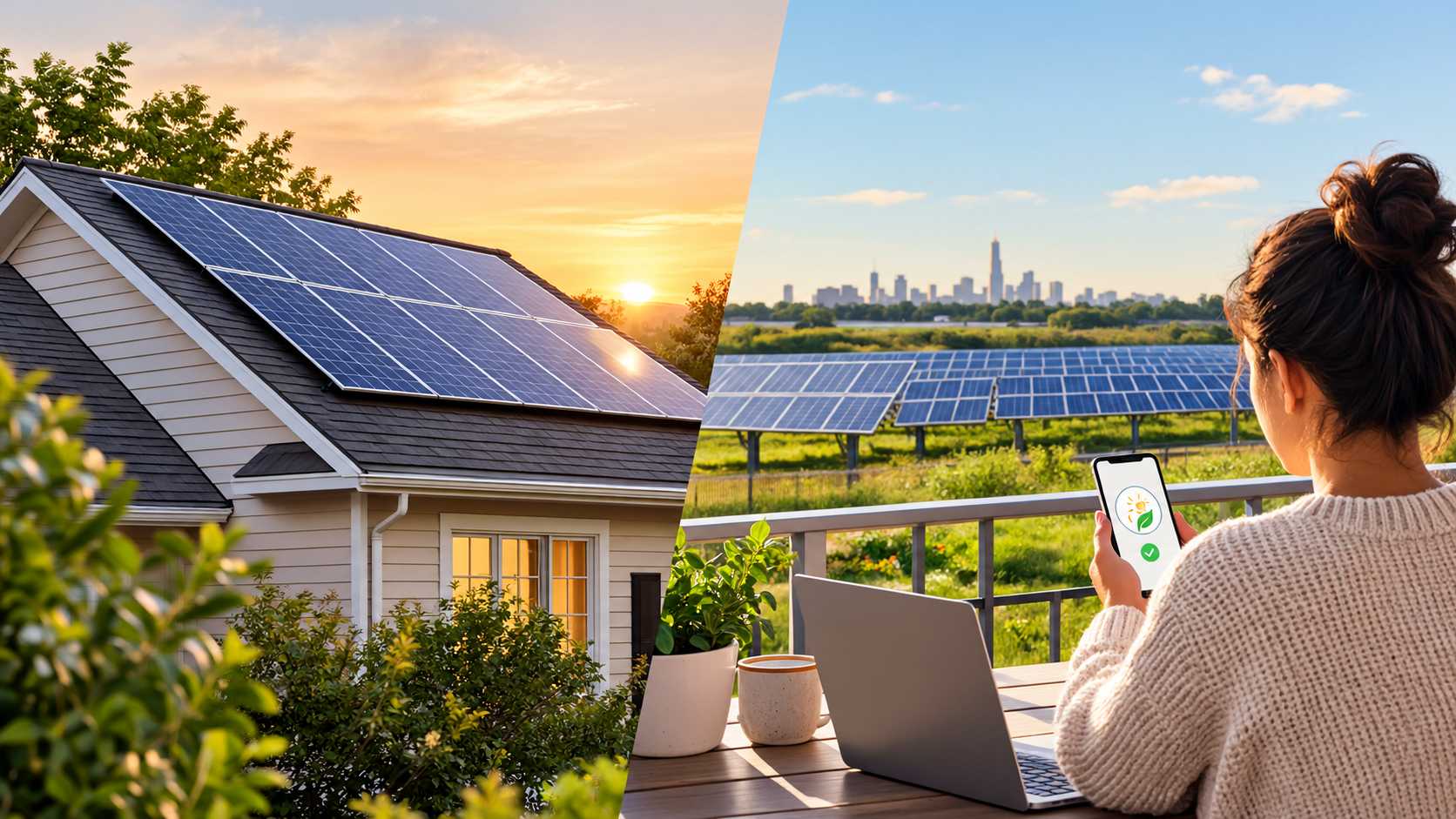
Solar panels on your roof and a subscription to a community solar farm both get labeled “going solar,” but they’re financially nothing alike. One is a five-figure purchase on your house. The other is a sign-up with no equipment at all. If you’re trying to figure out which actually costs less, the honest answer depends on whether you own your roof, your credit situation, and what NYSERDA currently has available, not just which option sounds greener.
Here’s the real 2026 comparison, built from current install costs, the recently changed federal incentive picture, and how community solar programs actually bill you.
What Community Solar and Solar Panels Actually Are
Home solar panels mean a physical system installed on your roof (or ground-mounted on your property) that you own or finance directly. You’re buying hardware, hiring an installer, and taking on the maintenance that comes with it.
Community solar works differently. You subscribe to a share of a solar farm, a larger solar array built elsewhere, usually a stand-alone field, not on your property, and the electricity it generates gets credited against your utility bill. No panels touch your roof, no installation crew visits your house, and you can subscribe whether you rent, own, or live in a condo with no usable roof space at all.
CPG doesn’t install solar panels, operate a solar farm, or run a community solar program itself. What CPG does offer is a renewable energy supply option (more on that further down), which is a different thing worth understanding clearly before you decide between the two paths below.
Install Solar Panels Cost: The Real 2026 Numbers for NY.
This is where the math changed significantly for 2026, and it’s the part most older articles get wrong.
As of October 2026, the average install solar panels cost in New York runs around $2.77 per watt. For a typical 7 kW residential system, that puts the installed price before incentives somewhere around $19,385.
Here’s the change that matters most: the 30% federal solar tax credit (Section 25D) expired on December 31, 2025. Homeowners installing solar panels in 2026 no longer get that credit at all, no phase-down, no partial year. What’s still available in New York:
- NY State Solar Energy System Equipment Credit: 25% of system cost, capped at $5,000
- NY-Sun Megawatt Block incentive: standard-income rebates have closed in the Con Edison and Upstate regions as of early 2026; the remaining active residential incentive is the NY-Sun Affordable Solar Residential Incentive, paying roughly $0.40 per watt, limited to households at or below 80% of area median income
Translation: unless you qualify for the income-based program, a homeowner installing solar panels in NY today is financing a $19,385 purchase with a $5,000 state credit as the main offset, a meaningfully different picture than the “30% off” math that circulated for years.
Community Solar Programs: How Do They Work ?
Community solar programs work on a subscription model instead of a purchase. You sign up for a share of a solar farm’s output, sized to roughly match your typical electricity usage, and that farm’s production shows up as a credit on your utility bill based on how much electricity it generated for your share that month.
The typical structure:
- No upfront cost. You’re not buying equipment, so there’s no $19,385 installation bill to finance
- Monthly subscription fee, usually priced below the value of the bill credit you receive, so the net effect is a modest discount on your electricity costs
- No maintenance responsibility. The solar farm’s operator handles upkeep, not you
- Cancel anytime provisions are common, unlike a decade-plus equipment investment
Because there’s no equipment purchase, there’s no install solar panels cost to offset with incentives in the first place. The financial case for community solar isn’t built on tax credits, it’s built on whether the subscription discount consistently beats what you’d otherwise pay.
NYSERDA’s Role: What’s Actually Available in 2026?
NYSERDA runs both programs under its NY-Sun initiative. For community solar specifically, NYSERDA’s own description is direct about who it’s for: renters, condo dwellers, homeowners, and small businesses, in other words, anyone with an electric bill, not just people who own a roof suited to solar panels.
Where NYSERDA’s role differs between the two paths: for home solar panels, NYSERDA’s incentive is a one-time per-watt rebate paid toward installation. For community solar, NYSERDA’s role is largely regulatory, setting up how the bill-crediting mechanism works through something called net crediting, rather than paying a direct incentive to the subscriber.
If you’re weighing either option, NYSERDA’s community solar resources are worth checking directly before signing anything, since availability and subscription terms vary by developer and utility territory.
The Hidden Costs of Home Solar Panels: Cleaning, Maintenance, and Upkeep.
Installation cost isn’t the end of the home solar panel math. Solar panel cleaning typically runs $150 to $500 per visit, recommended once or twice a year depending on pollen, dust, and local debris. Combined with periodic inspection, annual maintenance for a home solar panel system commonly runs $300 to $850 a year over the system’s life. Inverter replacement, usually needed once every 10 to 15 years, typically adds $1,500 to $3,000 when it comes due.
None of this applies to community solar. Since you don’t own equipment, there’s no panel to clean, no inverter to replace, and no roof access to arrange. This is one of the more overlooked parts of the comparison: a home solar panel system’s true cost includes a couple hundred dollars a year of upkeep that a community solar subscription simply doesn’t carry.
Renewable Energy Credits: Does Community Solar Still Count as Green Energy?
Every unit of solar electricity generated, whether from your own rooftop panels or a shared solar farm, creates renewable energy credits (RECs). A REC represents the environmental attributes of that renewable generation, separate from the electricity itself, and is the mechanism used to verify and track green energy claims.
With home solar panels, you typically own the RECs your system generates, and depending on your state’s rules, may be able to sell them separately. With community solar, the RECs are usually retained by the solar farm operator as part of the subscription structure, since you’re buying the bill credit, not the underlying renewable attribute.
This is also where CPG’s own green energy option fits into the picture, as a third path separate from both of the above. CPG’s Power Green 60 and Power Green 100 supply plans work by CPG purchasing RECs on your behalf, matching a portion or all of your electricity usage with renewable generation, without requiring rooftop panels or a community solar subscription. It’s not a substitute for either path above, it’s a different way to add renewable content to your energy mix if neither rooftop solar nor a community solar subscription fits your situation.
Which One Actually Costs Less for You?
- Solar panels likely cost less over time if: you own your home long-term, have good roof exposure, and qualify for the NY-Sun Affordable Solar income-based incentive
- Community solar likely costs less upfront if: you rent, have a shaded or unsuitable roof, or don’t want a five-figure financed purchase and ongoing maintenance responsibility
- Neither may be available or ideal if: your utility territory has limited community solar capacity or you’re not ready for either a long subscription commitment or a major home investment
Whichever direction fits your home, it’s worth comparing your current electricity supply plan either way. If you want to check how CPG’s fixed-rate and green supply options stack up against what you’re paying now, our Why CPG page covers what’s actually included. Renters specifically weighing these options should also see our guide on switching energy suppliers as a renter, since that overlaps heavily with who community solar is built for.
Curious how a renewable supply plan compares to your current rate? Shop CPG’s energy plans and see what Power Green 60 or 100 looks like for your usage.
FAQs
1. Is community solar cheaper than putting panels on my roof?
Up front, yes, because you aren’t buying or installing anything. Over the long run, rooftop usually wins if you own the home and plan to stay for years. What you end up with comes down to your installation quote, the tax credits you qualify for, upkeep, and how much power you use.
2. What does a solar install cost in New York right now?
EnergySage puts the average at $2.77 per watt. For a 7 kW system, that’s about $19,385 before incentives. Your own quote will shift with your roof, the equipment and whoever does the work.
3. I rent. Can I still get community solar?
You can. No panels, no property ownership needed. You do need an eligible utility account, and what’s on offer varies by utility territory and provider.
4. Is there still a solar tax credit in New York?
The state one, yes. It covers 25% of qualifying costs, capped at $5,000, if you meet the eligibility rules. The federal 25D credit is a different story: it doesn’t apply to anything paid for after December 31, 2025.
5. Does community solar cost anything to start?
Often not. Many subscriptions have no sign-up fee and no equipment cost. Fees, billing setup and cancellation terms differ from one provider to the next, so read the agreement before you sign.
6. How much will I actually save?
It’s the value of the solar credits on your bill minus what you pay for the subscription. Some providers give you a discount on those credits, but the size of it is set by your contract and by how much the farm produces that month. Look at the stated discount and any extra fees first.
7. What changes on my electric bill?
Your utility still delivers your power. The credits from your slice of the solar farm show up on that bill. The subscription fee may come as a separate bill from the provider or be folded into one combined statement, depending on the program.
8. Do panels need upkeep?
Some, yes. Rooftop systems get cleaned and inspected now and then, and repairs happen. Inverters often need replacing at some point in the system’s life. What that costs depends on your equipment and your site. With community solar, you generally don’t pay for any of it directly.
9. Can I cancel whenever I want?
Not always. A few providers let you leave with no fee. Others require notice or lock you into specific terms. If you think you might move, check the cancellation policy before you commit.
10. My roof is shaded. Can I still join?
Yes, and that’s a big reason people pick community solar. Shady roof, unsuitable roof, rental, condo: none of it matters, because you’re subscribing to a share of a solar project somewhere else.
11. How is community solar different from a green electricity plan?
Community solar gives you a share of a specific solar project and credits on your utility bill. A green supply plan, like CPG’s Power Green plans, works through renewable energy credits (RECs) that match some or all of your usage with renewable generation. Different mechanics, different billing.
12. Is rooftop solar still worth it without the federal credit?
It can be, if you own the home, your roof is a good fit, and you’ll be there long enough to collect on the lower bills. The New York state credit helps too. Before deciding, put the install quote, incentives, financing costs and your expected savings side by side.


