

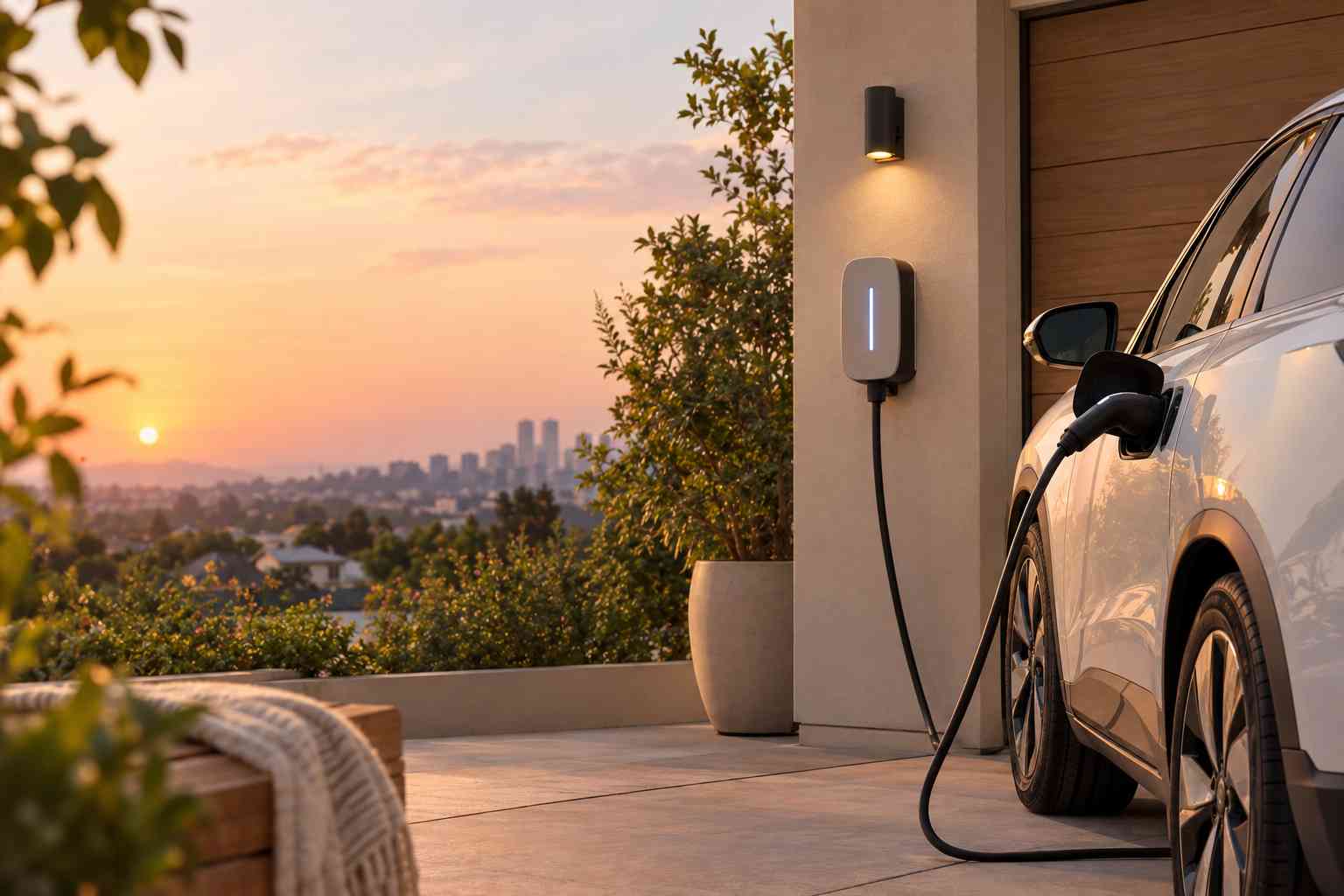
Buy an electric vehicle and you inherit a strange new habit almost overnight: watching the clock before you plug in. Most new electric vehicle owners don’t realize this at first. They just plug in whenever, the same way they’d fill a gas tank, and only later discover that when you charge matters just as much as how much you use.
That’s where TOU rates come in. Pair time of use pricing with an electric vehicle and you’ve got two systems built to reward exactly the same behavior, shifting usage into cheap, off-peak hours. Few household purchases line up with a rate structure this cleanly.
TL;DR
- TOU pricing rewards shifting usage to off-peak hours, and an EV is one of the few household loads flexible enough to fully take advantage of that.
- Con Edison’s off-peak TOU rate runs roughly 5 cents per kWh from midnight to 8 a.m., a fraction of peak and Summer Super-Peak pricing.
- SmartCharge New York pays for off-peak charging while keeping you on the standard rate, but you can’t combine it with TOU, it’s one or the other.
- National Grid, PSEG, PECO, and PPL Electric each run separate EV rate programs with different peak windows and rules.
- Demand charges are rare on residential accounts but worth checking if your rate structure includes one.
- Scheduling your charger through an app, rather than manually timing it, is the easiest way to actually capture off-peak savings.
- Switching your whole home to TOU affects every appliance, not just your EV, so compare your full usage pattern before committing.
- NYSERDA’s Drive Clean Rebate offers $500 to $2,000 off eligible EV purchases, separate from ongoing charging savings.
Why This Pairing Actually Works
TOU pricing splits your day into peak and off-peak windows, charging more when the grid is under strain and less when demand drops off. Most households have some flexibility here, maybe you can run the dishwasher later, maybe not. An EV is different. It doesn’t care when it charges. Plug it in at midnight or plug it in at 6 p.m., the car doesn’t notice, only your wallet does.
That flexibility is rare. Heating and cooling need to happen when you’re home and uncomfortable. Cooking happens when you’re hungry. But an EV sitting in the driveway overnight has eight hours of dead time that would otherwise go to waste, and TOU electricity rates exist specifically to reward someone who can fill that window instead of drawing power during the 4 p.m. rush everyone else creates.
What Off-Peak Charging Actually Saves You
Con Edison’s published Time-of-Use rate structure puts off-peak hours from midnight to 8 a.m., with a delivery rate around 5 cents per kWh, compared to considerably more during the day and during Summer Super-Peak windows (2 to 6 p.m., weekdays, June through September). Charge a typical EV’s nightly top-off entirely within that window and the delivery-charge savings alone add up fast over a year.
This is on top of Con Edison’s separate SmartCharge New York program, which pays participants directly for off-peak charging while they stay on the standard residential rate rather than switching to TOU. You can read Con Edison’s own breakdown of how EVs affect your bill for the full mechanics, including the trade-off: choosing TOU makes you ineligible for SmartCharge, and vice versa. You get one or the other, not both.
National Grid, PSEG, PECO, and PPL Electric each run their own version of EV-specific pricing too, and none of them mirror Con Edison’s setup exactly. Peak windows, off-peak rates, and enrollment rules all shift by utility, so the math genuinely changes depending on your address.
Demand Charges: The Part Most EV Owners Never Hear About
Here’s a wrinkle that rarely gets mentioned in beginner EV guides. Some rate structures, more common commercially than residentially, include a demand charge, a separate fee based on your single highest moment of electricity draw during a billing period, not your total usage.
Why does this matter for an EV owner? A Level 2 charger pulling 30+ amps for hours can register as a real spike if your account happens to be on a demand-based structure. Most residential customers never encounter this, but it’s worth checking your specific rate plan before assuming your charger’s draw is invisible to your bill in every possible sense.
How Much Does This Actually Change Your EV Charging Cost?
The math depends on your usage, but the direction is consistent: shifting charging into off-peak hours lowers your EV charging cost, sometimes by a meaningful margin, since the delivery portion of time of use electricity pricing is structured specifically to cost less overnight.
Take a driver charging 300 kWh a month. On a flat rate, that’s a fixed number no matter when the car is plugged in. Under time of use electricity rates, that same 300 kWh charged entirely off-peak can cost noticeably less than the flat-rate equivalent, purely because of when the electrons flow rather than how many of them there are. Compare electric rates side by side, flat versus TOU, using your own actual charging window before assuming either one wins by default.
Setting Up Your Charging Schedule
None of this savings materializes automatically. You have to actually schedule around it.
Most Level 2 chargers, and increasingly Level 1 setups too, let you set a start time through an app rather than plugging in and hoping you remember to unplug before morning. Set it once for whatever your utility’s off-peak window is, and the car handles the rest. No nightly decision-making required.
A few things worth checking when you set this up:
- Confirm your actual off-peak window. Con Edison’s differs from PSEG’s, which differs from PECO’s.
- Check whether your utility requires a separate meter for EV-specific rates, some do, some don’t.
- Decide between a straight TOU switch versus an incentive program like SmartCharge, since many utilities structure these as mutually exclusive.
- Revisit your setup seasonally. Summer Super-Peak windows in particular can shrink your cheap-charging hours during the exact months your AC is also working overtime.
Comparing Electric Rates Before You Commit
Switching your whole home to a time-of-use structure is a bigger decision than it might seem, since it doesn’t just apply to EV charging, every appliance in your house now runs on the same peak/off-peak pricing. Before making that switch, it’s worth taking a close look at your overall usage pattern, not just your car’s.
If you’re not sure your home’s smart meter even supports TOU billing, our guide on smart meters walks through how to check. And if TOU turns out to be the wrong fit once you’ve run the numbers, comparing a fixed vs. variable rate plan is worth doing anyway, since your electric vehicle’s added load makes your overall supply rate matter more than it used to.
For a deeper look at how time-of-use electricity pricing works beyond just EVs, our full breakdown of TOU rates covers the mechanics utility by utility.
A Quick Scenario
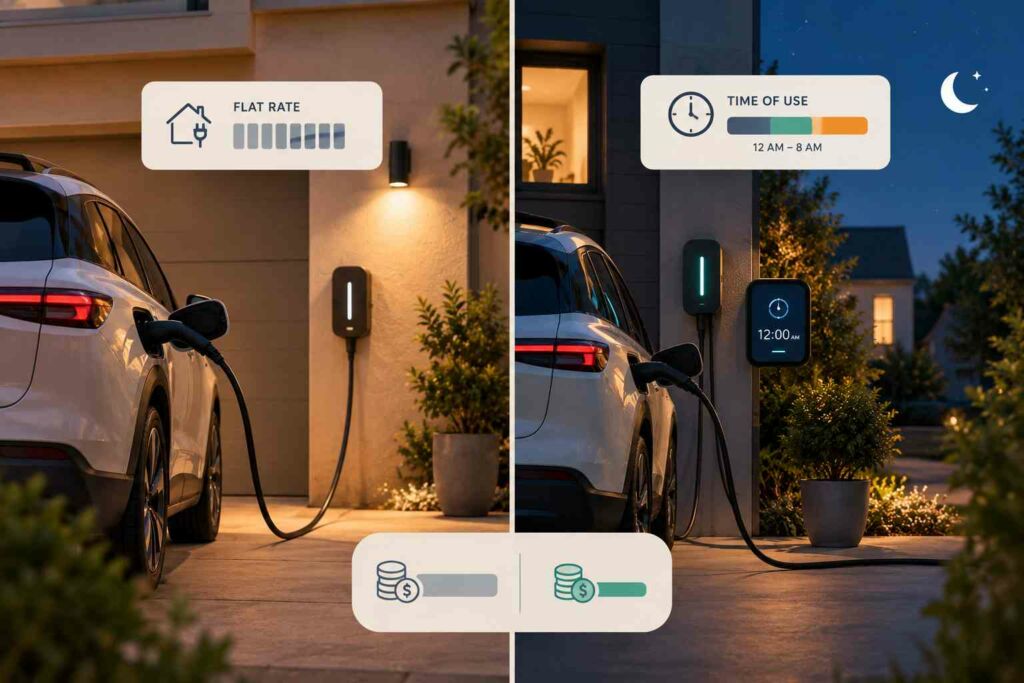
Picture two neighbors, both driving the same electric vehicle, both plugging in most nights. One stays on their utility’s flat rate. The other switches to time of use pricing and sets their charger to start at midnight without fail.
Over a year, the difference isn’t dramatic on any single night, a few cents here, a few cents there. But multiplied across 300-plus charging sessions, it becomes a real gap, one that shows up clearly the moment you compare electric rates on paper rather than just guessing. The second neighbor didn’t drive less or charge less. They just moved the same electricity to cheaper hours and let the rate structure do the rest.
Rebates Worth Knowing About Alongside Your Rate Plan
TOU savings compound nicely with New York’s existing EV incentive programs. NYSERDA’s Drive Clean Rebate knocks $500 to $2,000 off the purchase or lease of more than 60 eligible EV models at the point of sale, separate from whatever you save later on charging costs. It’s a purchase-time incentive, not a charging discount, but it’s worth stacking mentally against your long-term TOU savings when you’re first running the numbers on whether an EV makes financial sense.
If you want a broader, state-by-state look at EV incentives beyond just New York, the Department of Energy’s Alternative Fuels Data Center tracks laws and incentives nationally, useful if you’re comparing notes with someone out of state.
Is It Actually Worth Switching to TOU Just for an EV?
Depends on your charging habits, honestly. If your car sits plugged in overnight regardless, and you’re not running major appliances during peak afternoon hours anyway, TOU is close to a free win. If your household already runs hot during the day, work-from-home setups, older kids home after school, a home office pulling power from 9 to 5, TOU could actually cost you more on the rest of your bill than it saves you on charging.
Run both scenarios before switching. Compare what your electric rates would look like under TOU against your current flat structure, factoring in your car’s charging pattern specifically, not just your general electricity use.
See What TOU Could Look Like for Your Home
Every household’s usage pattern is different, and the only way to know if TOU pairs well with your EV is to look at your actual numbers. Compare your current rate against what a time-of-use or fixed plan would cost for your specific usage before making the switch.
Compare electricity plans now →
FAQs
Are all residential customers eligible to enroll in an EV time-of-use rate?
Depends entirely on your utility. Some just want an active residential account. Others ask for proof of EV ownership or a Level 2 charger already installed. Duquesne Light, Con Edison, and most other NY and PA utilities each run their own rules here, so there’s no single answer that applies everywhere.
When does enrollment actually take effect?
Usually one to two billing cycles out. Don’t expect your very next bill to reflect the new rate, most utilities need that window to process the switch and start applying peak and off-peak pricing correctly.
How do I know if a TOU rate is even right for me?
Look at when your EV and big appliances actually run. Mostly overnight? TOU probably saves you money. Spread out through the day, dishwasher at noon, AC running while you work from home? A flat rate might genuinely serve you better.
Can I enroll in both a Time-of-Use rate and an EV charging program at the same time?
Usually not. Con Edison’s SmartCharge, for instance, makes you pick one or the other. Some utilities allow overlap, most don’t, so check the specific program rules before assuming you can stack them.
How do I cancel once I’ve enrolled in a TOU rate?
Call your utility’s customer service line. Some let you switch back immediately, others lock you into a minimum enrollment period first. Read the fine print before you sign up, not after you’ve decided you want out.
What are the off-peak hours for electricity in New York?
It changes by utility. Con Edison runs midnight to 8 a.m. Other providers in New York and Pennsylvania set their own windows entirely, so this isn’t a one-size-fits-all number, confirm with whoever actually bills you.
Should I charge my EV to 100% every night?
Not really, no. Most manufacturers suggest keeping daily charging around 80-90% to protect long-term battery health, saving a full charge for road trips. Worth checking what your specific car’s manual actually recommends.
What’s the cheapest time of day to charge an EV?
Overnight, generally somewhere between midnight and early morning, is when grid demand bottoms out. On a TOU rate, that’s also when the per-kWh price is lowest, which is exactly why EV charging and off-peak hours pair so well.
Which appliances should you keep off during peak hours on a TOU rate?
The big power draws: EV chargers, dishwashers, dryers, central air. Move those specifically into off-peak hours and you’ll capture most of what a TOU rate is actually designed to save you.
What’s the single most expensive thing to run in a typical home?
Usually central air conditioning or an EV charger, depending on the season. On a flat rate, timing doesn’t matter either way. On TOU, shifting either one off-peak changes the math noticeably.


